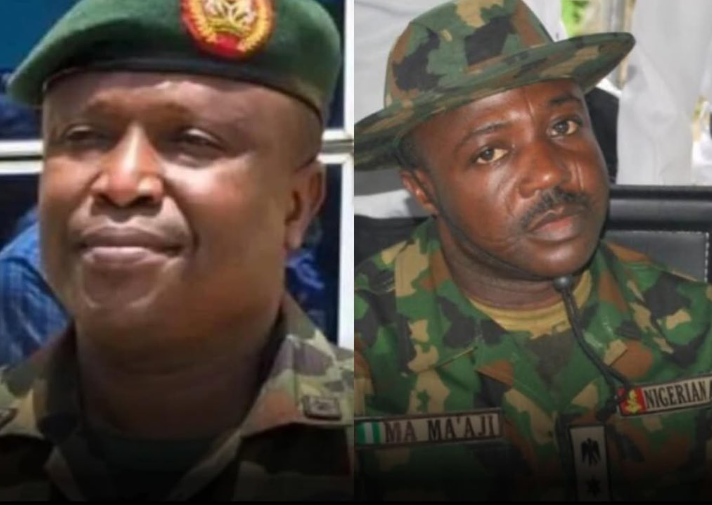
Nigeria’s political and military circles are reeling from fresh revelations surrounding a foiled coup attempt against President Bola Ahmed Tinubu’s administration, with sixteen senior military officers now in detention as investigators dig deeper into what is being described as one of the most significant internal security breaches since the return of democracy in 1999. It was reported that the officers, drawn from the Army, Navy, and Air Force, are being held under tight security as interrogations continue over their alleged involvement in the conspiracy.
According to multiple security sources, fourteen of the detained officers belong to the Nigerian Army, while one officer each from the Navy and Air Force have also been implicated. The Army officers are primarily from the Infantry Corps, signaling the seriousness of the alleged plot, as these units represent the backbone of ground combat operations. Of the fourteen soldiers from the Army, twelve hail from the Infantry, one from the Signals Corps, and one from the Ordnance Corps, indicating that the network of suspects may have spanned across operational and logistical lines within the military’s command structure.
The ranks of the officers being questioned underline the gravity of the case. They include one brigadier general, one colonel, four lieutenant colonels, five majors, two captains, and a lieutenant. The Navy’s representative in the case is a lieutenant commander, while the Air Force officer being detained holds the rank of squadron leader. These are not junior personnel; they are men who have spent years, in some cases decades, within the system, and whose loyalty to the state has now come under intense scrutiny.
Among the detained, Brigadier General Musa Abubakar Sadiq has emerged as the alleged ringleader. Sadiq, who hails from Nasarawa State, is a member of the Nigerian Defence Academy’s Regular Course 44 and is said to have a checkered history. Sources recall that he was previously detained in 2024 over allegations related to the diversion of relief materials and military equipment. Though he was released after an internal review, his reappearance at the center of another high-profile investigation has fueled speculation about the nature and depth of the network under probe.
Also held is Colonel M.A. Ma’aji from Niger State, a member of the 47 Regular Course, who is alleged to have played a key strategic role in coordinating the purported plot. Ma’aji is a seasoned officer who once commanded the 19 Battalion in Ondo State and later served under Operation Delta Safe in the Niger Delta. His knowledge of tactical operations and his recent postings have raised eyebrows among investigators, who are said to be tracing his movements and communications over the past several months.
Other names that have surfaced include Lt. Col S. Bappah from the Signals Corps in Bauchi State, Lt. Col A.A. Hayatu from Kaduna State, and Lt. Col M. Almakura, another officer from Nasarawa State. The list extends further to include Majors A.J. Ibrahim, M.M. Jiddah, M.A. Usman, D. Yusuf, and I. Dauda, Captains Ibrahim Bello and A.A. Yusuf, as well as Lt. S.S. Felix. From the Navy, Lt. Commander D.B. Abdullahi is reportedly in custody, alongside Squadron Leader S.B. Adamu from the Air Force.
Security analysts say the pattern of states and corps represented among the suspects hints at a well-organized network, possibly operating across different commands. Yet, no clear motive or public statement has been released to explain what might have driven the alleged plot. Whether the officers acted out of political ambition, internal grievances, or external influence remains unknown.
The Defence Headquarters, for its part, has maintained a cautious silence. The only official response so far has been a denial that the supposed coup attempt had any link to the scaled-down Independence Day celebrations on October 1, which many Nigerians had initially speculated might have been connected. Sources within the military establishment suggest that authorities are deliberately keeping public communications minimal to prevent panic and preserve the integrity of the ongoing investigation.
Meanwhile, inside the barracks, tension is reportedly high. Soldiers are said to be whispering about the arrests and the possible implications for their colleagues. Senior officers have been instructed to avoid discussing the matter outside official channels, and tight restrictions have been placed on movement and access to classified communication networks. The military police and intelligence units are believed to be monitoring conversations within several formations across the country, particularly in Abuja, Kaduna, and Maiduguri, where some of the detained officers had previously served.
The alleged coup plot, if proven true, would mark a stunning challenge to Nigeria’s democratic order under Tinubu’s administration. Since taking office in May 2023, President Tinubu has faced waves of criticism over economic hardship, subsidy removal, and insecurity. While such pressures are not unusual for Nigerian leaders, they have historically provided fertile ground for discontent within the ranks of the armed forces. Analysts recall that previous coup rumors during the Buhari administration were swiftly quashed, but none reached this level of detention involving such a high number of senior officers.
Some political observers have pointed out that the lack of transparency from the government could fuel speculation and mistrust. “When a democracy starts seeing multiple officers detained over alleged coup plots, and no one is told the real story, it can create fear, confusion, and suspicion even among civilians,” one security expert said. Others, however, argue that discretion is necessary in national security cases of this magnitude, given the potential consequences for the stability of the country.
For now, the officers remain in custody, and their fates are uncertain. Military investigators are said to be combing through phone records, bank transactions, and intelligence reports to establish links, both local and international. There are also unconfirmed reports that a few civilians have been invited for questioning, possibly for aiding or abetting the alleged conspiracy.
At the Aso Rock Villa, officials have remained tight-lipped. Presidential aides have declined to issue any comment on the development, merely emphasizing that the government remains focused on maintaining law and order. Insiders say the President has been briefed regularly on the situation and has instructed that the matter be handled strictly within the chain of command, without political interference.
As Nigeria waits for clarity, questions linger about what this incident reveals about the morale within the armed forces. Has discontent reached dangerous levels? Are internal divisions deepening under the surface? Or is this simply an isolated case of indiscipline being blown out of proportion? Until the Defence Headquarters or the Presidency issues an official statement, Nigerians can only speculate on the true nature of the alleged plot.
One thing, however, is certain: the specter of a coup, even a failed one, casts a long shadow over any democracy. The arrests of sixteen senior officers — men sworn to defend the nation — underscore both the fragility and the resilience of Nigeria’s political order. As investigations continue, all eyes remain on the military’s next move, and on how President Tinubu’s administration will navigate the uneasy calm that has settled over the country’s defense establishment.
If proven false, the case could expose deep cracks in intelligence handling and internal politics within the military. But if proven true, it would mark a sobering reminder that even after a quarter century of democracy, the ghosts of Nigeria’s coup-riddled past have not completely vanished.
Popular Posts

Gospel Artist Victor Thompson’s 5th Wedding Anniversary Photos Spark Praise, Banter, and a Fresh Conversation on ‘Loving Good Things’
06 Dec, 2025
DJ DSF Sparks Debate as She Says It’s Better to Stay in Nigeria Than Do a Job You Hate in the UK
06 Dec, 2025
Bimbo Akintola Reveals Why She Supported Tinubu: “Someone Annoyed Me With Their Bullying”
06 Dec, 2025Scroll to Top