news
Court Gives Nnamdi Kanu Final Deadline to Defend Himself or Lose Right: November 5 Set as the Day of Reckoning
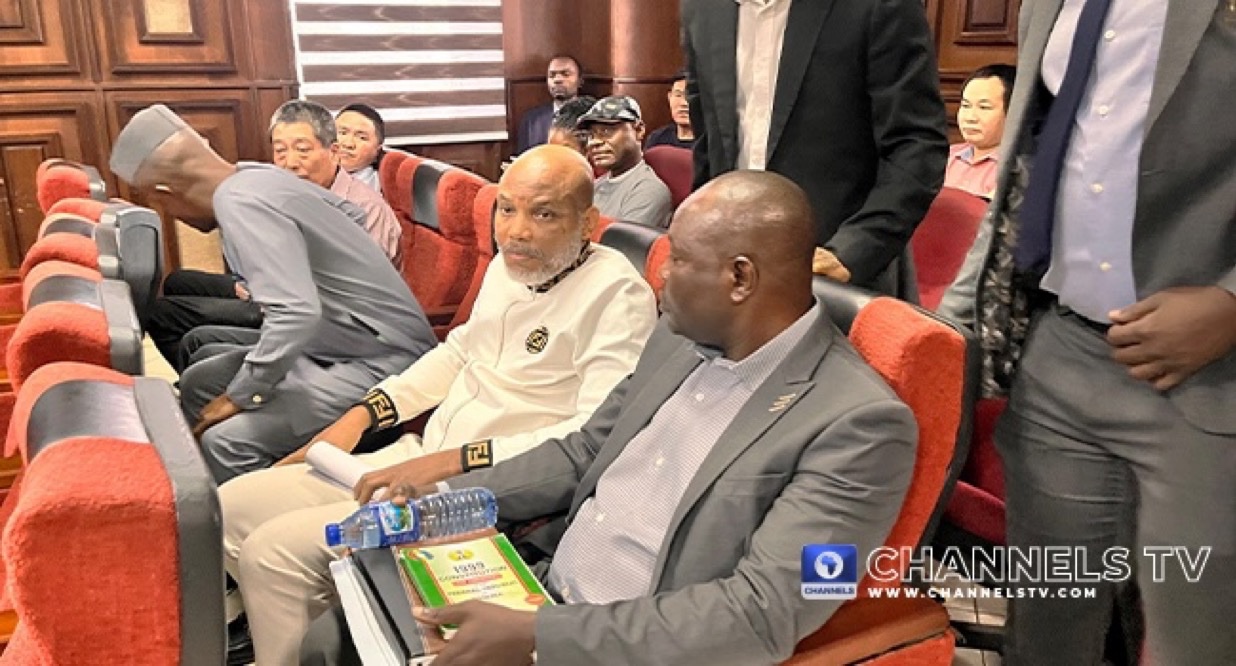
In a dramatic turn of events that has sent shockwaves through Nigeria’s political and legal circles, the Federal High Court in Abuja has given the detained leader of the Indigenous People of Biafra (IPOB), Nnamdi Kanu, until November 5, 2025, to open his defence in the long-drawn-out treason trial that has gripped national attention for years. The presiding judge, Justice James Omotosho, made the declaration after Kanu failed, for the fourth consecutive court sitting, to enter his defence following the prosecution’s closure of its case and the court’s dismissal of his no-case submission. The decision now puts the IPOB leader at a critical crossroads, as failure to act by the given date could mean forfeiting his constitutional right to defend himself against the serious charges brought by the Federal Government.
Tension filled the courtroom as Justice Omotosho, in his stern ruling, made it clear that the court would not continue to tolerate unnecessary delays. According to the judge, the matter has lingered far too long, and justice must not only be done but must be seen to be done — both for the accused and for the state. He emphasized that since the prosecution had already concluded its case and the court had overruled Kanu’s no-case submission, the logical next step was for the defence to begin. “This court has given ample opportunity for the defendant to present his case,” Justice Omotosho stated firmly. “If by the next adjourned date, which is November 5, the defendant fails to open his defence, the court will deem him to have forfeited his right to do so and will proceed accordingly.”
The ruling comes amid heightened public interest in the legal battle that has come to symbolize the broader struggle between the Nigerian state and separatist movements. For years, Nnamdi Kanu has remained one of the most controversial figures in Nigeria’s political landscape — hailed by his supporters as a freedom fighter advocating for the self-determination of the Igbo people, yet viewed by the government as a dangerous agitator whose rhetoric has inflamed ethnic divisions and incited violence. His trial, which began several years ago under charges of treasonable felony, terrorism, and unlawful possession of weapons, has been marred by adjournments, procedural battles, and a series of high-profile legal and political twists.
Observers say that this latest ruling could be a defining moment in a case that has often felt like a legal stalemate. Kanu’s legal team has repeatedly argued that their client cannot receive a fair trial in Nigeria, citing alleged violations of his human rights, including his extraordinary rendition from Kenya in 2021 and prolonged detention by the Department of State Services (DSS). They have also maintained that the charges against him are politically motivated and lack merit. However, the court has remained steadfast in its insistence that the trial proceed according to established legal procedure, regardless of the political undertones surrounding it.
Outside the courthouse, supporters of Kanu gathered in large numbers, chanting pro-Biafra slogans and demanding his immediate release. Many wore T-shirts emblazoned with his image and held placards accusing the government of persecution. Security was visibly tight, with heavily armed DSS operatives and police officers stationed at strategic points around the court premises to prevent any outbreak of violence or disruption. Despite the tense atmosphere, proceedings inside the courtroom were largely orderly, though the mood was unmistakably tense as Justice Omotosho delivered his warning.
Inside the legal community, the decision has sparked intense debate. Some legal analysts view the judge’s ultimatum as a fair and necessary step to ensure the integrity of the judicial process. They argue that after years of back-and-forth motions, it is time for the defence to finally present its case so that the trial can move toward a conclusion. Others, however, see it as a harsh move that could further complicate an already politically sensitive case. “While the court is right to demand progress, it must also balance the rights of the accused,” one constitutional lawyer noted. “If the defence is not adequately prepared or if there are genuine issues affecting Kanu’s ability to participate meaningfully, forcing him to forfeit his right to defence could raise serious questions on appeal.”
For many Nigerians, the Kanu trial has long transcended the courtroom and become a reflection of deeper issues in the country — from ethnic tensions and questions of national unity to the limits of free speech and dissent. His broadcasts from abroad once drew millions of listeners and energized a new generation of separatist sympathizers, particularly in the Southeast, who saw him as a voice of defiance against perceived marginalization. But the movement he led has also been linked to violent clashes, attacks on security agents, and economic disruptions in the region, leading the government to classify IPOB as a terrorist organization.
As November 5 approaches, the stakes could not be higher. If Nnamdi Kanu fails to defend himself, the court may proceed to judgment based solely on the prosecution’s evidence, a scenario that could have profound legal and political implications. His lawyers are expected to meet urgently in the coming days to decide their next move, with some insiders suggesting they may file a fresh motion seeking to delay proceedings on grounds of procedural fairness or health concerns. Meanwhile, IPOB spokespersons have already condemned the latest ruling, accusing the judiciary of acting under government pressure and vowing that the movement will continue to demand Kanu’s unconditional release.
The Federal Government, for its part, has maintained that the case is strictly a matter of law and order, not politics. Officials have repeatedly insisted that Nnamdi Kanu must face the consequences of his actions and that his trial represents a necessary stand against those who seek to destabilize the nation. Yet, for many, the optics of the situation remain complex. Every new development in the courtroom seems to reignite old debates about justice, fairness, and the meaning of freedom in a diverse and divided country.
With the court’s deadline now firmly set, all eyes turn to November 5 — a date that could either mark the beginning of Kanu’s defence or the end of his opportunity to be heard. The coming days are expected to bring intense legal maneuvering, heightened public attention, and perhaps even international scrutiny. Whether Nnamdi Kanu steps forward to defend himself or not, one thing is certain: the outcome of this trial will reverberate far beyond the walls of the Federal High Court in Abuja, shaping Nigeria’s political landscape and testing the nation’s commitment to justice, unity, and the rule of law.
For now, as the gavel falls and the countdown begins, the courtroom drama of one man continues to mirror the struggles of an entire nation — a nation still wrestling with its past, its identity, and the uncertain promise of its future
Popular Posts

Nigeria Pulls Back Fighter Jet After Benin’s Failed Coup as Calm Returns to the Region
07 Dec, 2025
Nigerian fighter jets deployed to Benin Republic as military takeover triggers regional alarm
07 Dec, 2025
Arne Slot Fired in Stunning Shake-Up: Liverpool Rocked by Sudden Managerial Dismissal
07 Dec, 2025Scroll to Top