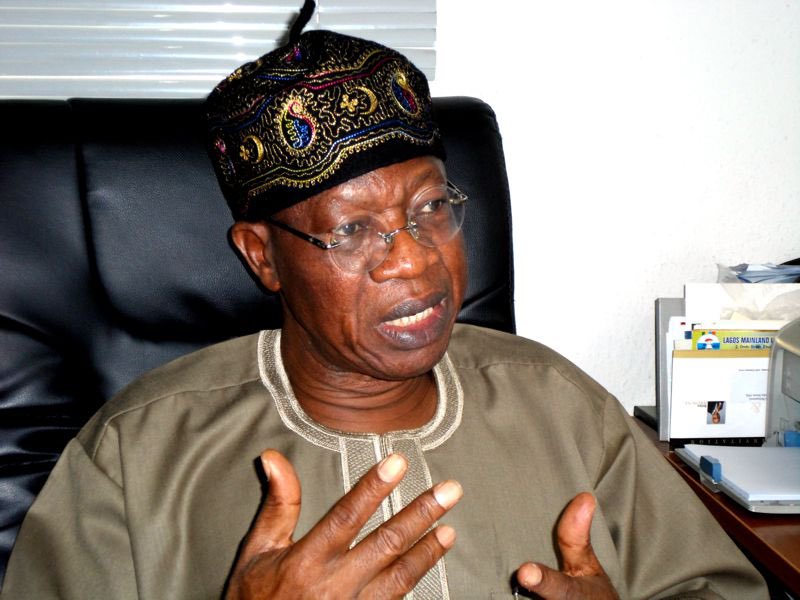
Ex-Minister Lai Mohammed Opens Up About Being P@ralyzed After Buhari’s D+ath
In a revelation that has captured the attention of the nation, former Minister of Information and Culture, Alhaji Lai Mohammed, has disclosed that he experienced days of physical p@ralysis upon hearing the shocking news of former President Muhammadu Buhari’s d+ath. Speaking candidly during a recent interview, Mohammed recounted the profound
In a revelation that has captured the attention of the nation, former Minister of Information and Culture, Alhaji Lai Mohammed, has disclosed that he experienced days of physical p@ralysis upon hearing the shocking news of former President Muhammadu Buhari’s d+ath. Speaking candidly during a recent interview, Mohammed recounted the profound emotional and physical impact that the news had on him, shedding light on the deep connections and loyalties that have shaped his political career and personal life.
The former minister described the moment as one of intense disbelief and emotional overwhelm. “When I heard about Buhari’s passing, I could not move for days. It was as if my body refused to respond to the reality of the news. I was completely p@ralyzed,” Mohammed said, his voice reflecting the gravity of the experience. He explained that the news struck him with such suddenness and finality that it left him incapacitated, struggling to process a reality that seemed almost surreal.
Mohammed’s admission has sparked widespread discussion across political and social media circles, with many expressing empathy and surprise at the level of physical reaction he experienced. While emotional responses to the loss of a national leader are not uncommon, the former minister’s account of being physically immobilized for days is a striking testament to the depth of his attachment and the psychological weight of Buhari’s d+ath. Political analysts have pointed out that such reactions highlight the intense personal and professional bonds that often underpin political relationships in Nigeria, where loyalty to leaders can extend beyond policy alignment into the realm of personal devotion.
The former minister went on to describe the period following Buhari’s d+ath as one of reflection and introspection. “Those days were incredibly challenging for me. Beyond the p@ralysis, there was a profound sense of loss and uncertainty about the future,” Mohammed recounted. He revealed that the experience forced him to pause and reassess his own life and career, as well as the direction of the country. In interviews following this revelation, he emphasized that Buhari had been more than just a political figure; he was a mentor and a guiding presence, whose leadership style and vision had left a lasting imprint on those who worked closely with him.
In addition to the personal impact, Mohammed acknowledged the broader national implications of Buhari’s passing. He highlighted the deep respect and admiration that many Nigerians held for the former president, noting that the collective sense of loss was palpable across the country. “Buhari’s d+ath was not just a personal loss for those of us who knew him; it was a national tragedy. The country lost a leader whose presence had shaped the political landscape for years,” he stated. Mohammed’s words underscore the emotional resonance of Buhari’s leadership and the void that his passing has left in the political and social fabric of Nigeria.
Observers have noted that Mohammed’s candid account provides a rare glimpse into the human side of political life, a perspective often overshadowed by policy debates and public scrutiny. While leaders are frequently viewed through the lens of their decisions and public persona, Mohammed’s experience reminds the public that political figures and their associates also navigate profound personal emotions and vulnerabilities. The former minister’s vulnerability in discussing his p@ralysis serves as a reminder that the pressures of political life are not confined to public duties but extend deeply into the personal realm.
Social media has been abuzz since Mohammed’s revelation, with Nigerians from various walks of life sharing their reactions. Many expressed sympathy and solidarity, highlighting the shared sense of grief that followed Buhari’s passing. Hashtags commemorating Buhari’s legacy and acknowledging the emotional toll on those close to him have trended on multiple platforms, reflecting the national resonance of Mohammed’s testimony. Some users drew parallels between Mohammed’s experience and their own reactions to the loss, emphasizing the deep emotional impact that the former president had on citizens and political associates alike.
Political commentators have also weighed in on the implications of Mohammed’s disclosure. Some argue that the former minister’s p@ralysis is emblematic of the intense loyalty and commitment that certain political actors have toward their leaders, particularly in a country where political affiliations often intersect with personal relationships. Others suggest that the revelation may serve as a cautionary tale about the mental and physical toll that sudden, life-altering news can have, particularly for those operating in high-stress political environments. Regardless of interpretation, the account has prompted a broader conversation about the interplay between emotional well-being and political life in Nigeria.
Beyond the political sphere, Mohammed’s experience has sparked discussions about the importance of mental health awareness and emotional support for individuals navigating intense professional and personal challenges. Mental health advocates have highlighted that physical reactions to grief and trauma, such as the p@ralysis Mohammed described, are not uncommon and underscore the need for accessible support systems for public figures and citizens alike. By sharing his experience publicly, Mohammed has inadvertently contributed to destigmatizing conversations around mental and emotional health, particularly in the context of national loss and leadership transitions.
In reflecting on his recovery, Mohammed emphasized resilience and the role of faith in navigating such a profound personal crisis. “It was a difficult period, but with the support of family, friends, and my faith, I gradually regained my strength and mobility,” he explained. He acknowledged that while the initial days were marked by immobility and despair, the process of healing was both physical and emotional, requiring time, patience, and reflection. Mohammed’s story of recovery provides a narrative of hope and perseverance, illustrating the human capacity to overcome even the most paralyzing experiences.
As Nigerians continue to process the legacy of former President Buhari, Mohammed’s revelations serve as a poignant reminder of the personal dimensions of national loss. His account underscores that behind the headlines and policy debates are individuals who experience profound emotional reactions, sometimes manifesting in unexpected ways. For many, Mohammed’s candidness offers a moment of connection and empathy, bridging the gap between political leadership and human vulnerability.
Ultimately, the story of Lai Mohammed’s p@ralysis following Buhari’s d+ath is not just about political loyalty or the impact of losing a leader. It is a testament to the complex interplay of emotion, identity, and responsibility that defines public service. It reminds citizens that political life is not solely a matter of strategy and governance but also a deeply human endeavor, shaped by relationships, loyalties, and the inevitable encounters with loss and grief. As the nation continues to navigate the post-Buhari era, Mohammed’s experience stands as a compelling narrative of the personal costs of public life, and the enduring influence of a leader who left an indelible mark on Nigeria.
Share this post
Related Posts
Awujale Stool Battle Intensifies as Court Rejects Wasiu’s Bid to Halt Succession, Sets January 14 for Fast-Tracked Hearing
The legal tussle surrounding the revered Awujale of Ijebuland stool took a dramatic turn on...
Trump’s Bold Diplomatic Move: Aiming for Ceasefire Amid Russia-Ukraine Conflict
In a bold diplomatic move, President Donald Trump has announced plans to reach out to...

Double Vision: Lady Stuns Social Media with Throwback of Her Mom in NYSC Uniform Beside Hers
In a world where social media thrives on surprises, nostalgia, and moments that tug at...