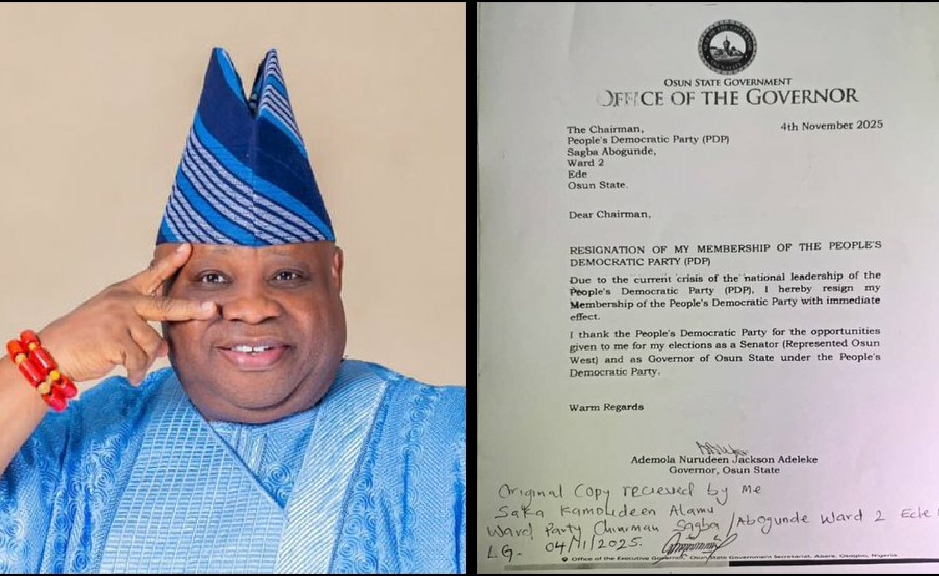
Governor Ademola Adeleke’s Resignation Letter Shakes PDP as Osun Politics Descends Into Uncertainty Ahead of 2026 Battle
Osun State slipped into full political turbulence this week after a resignation letter written by Governor Ademola Adeleke quietly on November 4 suddenly exploded across social media on December 2, plunging the Peoples Democratic Party (PDP) into deeper crisis and leaving the governor’s 2026 re-election bid hanging in the balance.
Osun State slipped into full political turbulence this week after a resignation letter written by Governor Ademola Adeleke quietly on November 4 suddenly exploded across social media on December 2, plunging the Peoples Democratic Party (PDP) into deeper crisis and leaving the governor’s 2026 re-election bid hanging in the balance.
What began as a confidential communication has now escalated into one of the most dramatic political twists of the post-2023 era, revealing fractures so severe that the PDP may be heading toward total implosion in Osun and possibly beyond.
The letter, short but shocking, was addressed to the party’s hierarchy and cited a “lingering national leadership crisis” as Adeleke’s reason for walking away. The governor lamented what he described as a system trapped in internal battles, illegitimacy issues, and structural confusion—an environment he claimed could sabotage his administration and undermine the stability needed for governance.
Although dated a month earlier, the letter only surfaced publicly at a time when PDP factions in Osun were sharpening knives ahead of the governorship primary, turning what might have been a routine internal quarrel into a political earthquake.
The timing could not have been worse for the PDP. Adeleke, popularly known as the “Dancing Governor” but now stepping into a more strategic, hardened political posture, is seeking re-election in 2026. Under normal circumstances, his incumbency advantage should have given the PDP a united front. Instead, the leaked resignation letter has detonated a bomb inside the party at the very moment when they should be rallying around their most bankable candidate. The PDP now finds itself in a dilemma: risk losing Adeleke completely, or attempt a rushed reconciliation in a party already drowning in factional warfare.
Across the nation, political analysts were quick to connect the dots. The PDP has been limping since the 2023 election cycle, its internal organs weakened by battles involving figures like Nyesom Wike, whose post-presidential-election moves left the party divided between loyalty blocs, legal disputes, and shadow negotiations with rival power blocs.
Adeleke’s decision to step away from such a chaotic structure appears, to many observers, less like betrayal and more like survival. In a party where court judgments now determine national officers, where the legitimacy of the National Secretary is still being contested, and where a defective structure could nullify primary elections at any moment, Adeleke’s fears were neither exaggerated nor unfounded.
The reactions on X (formerly Twitter) were immediate and intense. Some users applauded the move, arguing that the PDP has become a trap filled with “snakes, landmines, and confusion.” They claimed Adeleke simply jumped out before the system consumed him, praising his timing as politically smart and necessary. Others expressed anxiety that the governor may be preparing to align with the All Progressives Congress (APC), a speculation that fueled heated debates throughout the day.
Supporters of the PDP accused the APC of engineering the chaos, while critics of Adeleke accused him of opportunism, insisting that the resignation was a calculated move designed to pave the way for a quiet political migration.
But behind the noise lies a deeper political reality. Without a legally recognized National Secretary, every primary conducted by the PDP risks being declared invalid by courts—a legal time bomb waiting to detonate. Already, senior lawyers have warned that any aspirant who emerges from a flawed primary may have their victory overturned, even after winning at the polls. This is the lose-lose environment Adeleke referenced, and one that threatens to erase not just his re-election plan but the PDP’s broader future in Osun.
Insiders close to the Osun Government House suggest the governor is now weighing three major options. The first is returning to the PDP if the national crisis stabilizes, an outcome that currently appears unlikely. The second is running under a new or smaller platform—a bold gamble that could reshape Osun’s political history. The third is joining a bigger structure, including the APC, if conditions force his hand. Each option carries enormous risks, and each has already begun sparking silent but intense lobbying among power brokers across the Southwest.
Meanwhile, the PDP in Osun has gone into panic mode. Elders have called emergency meetings, factions are pointing fingers, and party loyalists appear more confused than ever. The opposition, on the other hand, is celebrating the drama, framing it as proof that the PDP is incapable of offering stability, unity, or credible governance. As one viral X post put it: “If your umbrella is leaking, don’t be surprised when people start looking for shelter elsewhere.”
But the real story is still unfolding. Adeleke remains silent publicly, watching the storm from the sidelines while strategists around him map out the next big political move. His dance floor may have changed, but he is still very much the one leading the rhythm of Osun’s 2026 elections. And as the PDP slips deeper into chaos, one thing is clear: the governor’s resignation letter was not just a document—it was a warning shot, a political earthquake, and perhaps the beginning of a new chapter in Osun’s unpredictable future.
Share this post
Related Posts

From Music to politics: Banky W Hints at Political Comeback After Earning Master’s Degree from Georgetown
In a move that has reignited conversations around the intersection of celebrity and politics in...
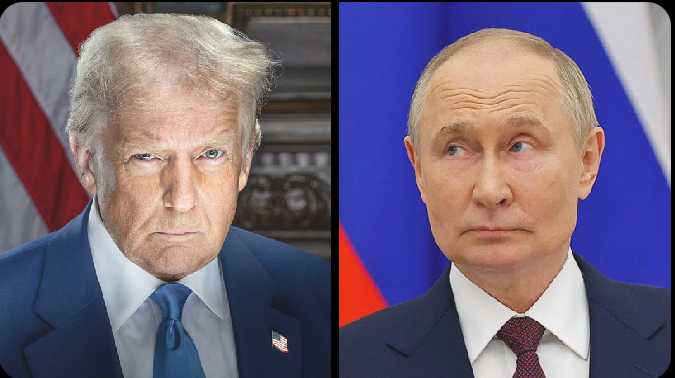
BREAKING: Trump Expresses Fury at Putin, Threatens Secondary Tariffs on Russian Oil
In a dramatic turn of events, U.S. President Donald Trump has voiced strong discontent with...

Sokoto State Spends N4.7 Billion on Student Exam Fees
The Sokoto State Government has revealed that it has spent a total of N4.7 billion...