Entertainment
“‘Let’s Make 2026 Great’: Trump Jr. and 50 Cent’s Christmas Exchange Sparks Cheers, Chuckles, and a Call for Calm”
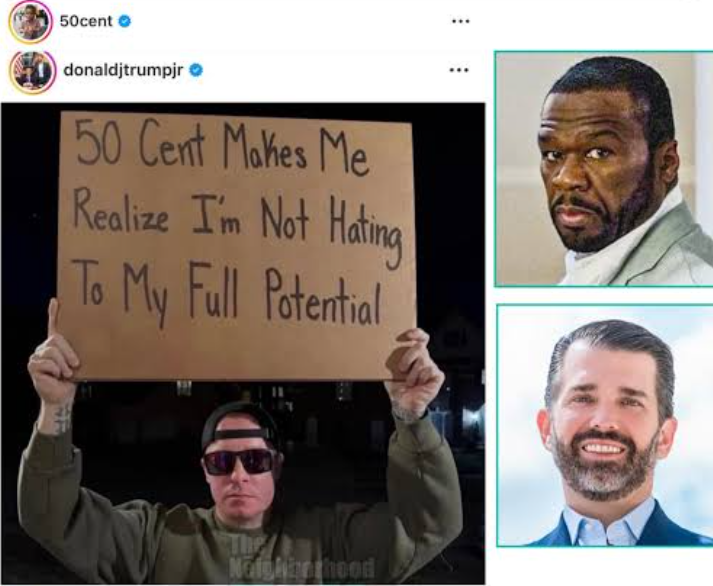
As Christmas Day settled in with its familiar mix of reflection, celebration and online banter, an unexpected exchange between Donald Trump Jr. and rap icon Curtis “50 Cent” Jackson cut through the holiday noise, drawing attention far beyond their individual followings. In a season often dominated by divisive rhetoric and political trench warfare, the brief but dramatic back-and-forth struck a different tone, one that blended humor, bravado and an unmistakable nod to peace, unity and self-improvement, even if delivered in the unapologetic style both men are known for.
The moment began on X, formerly Twitter, where 50 Cent, never one to miss an opportunity for wit or provocation, reacted to a post linked to Donald Trump Jr. with his trademark humor. “LOL. Yes let’s make 2026 great I’m in the gym getting ready now!” the rapper wrote, pairing the comment with the kind of tongue-in-cheek confidence that has defined his public persona for decades. The line was short, playful, and layered with meaning, hinting at politics, personal discipline, and the ever-present performative energy of social media.
Donald Trump Jr., a prominent political figure in his own right and a vocal presence online, responded in kind, keeping the exchange alive and instantly amplifying it to millions of followers. The interaction, though light on specifics, carried symbolic weight. Coming at Christmas, a period traditionally associated with peace and goodwill, the exchange was widely interpreted as a rare moment of levity between two figures who often operate in high-tension cultural and political spaces.
Almost immediately, screenshots of the posts began circulating across blogs, Instagram pages and WhatsApp groups, especially among politically engaged youth and pop culture audiences. Many users framed the exchange as a refreshing break from the usual hostility that dominates online political discourse. Others leaned into the humor, joking that Christmas had delivered an unlikely crossover episode between American politics and hip-hop culture.
The phrase “Let’s make 2026 great” became the focal point of the conversation. While clearly riffing on the familiar political slogan that has followed the Trump brand for nearly a decade, its use in this context felt deliberately casual. There was no policy proposal, no rallying cry, and no direct appeal to voters. Instead, it came across as a cultural wink, a reminder of how deeply political language has seeped into everyday entertainment and online jokes.
For 50 Cent, whose career has long thrived at the intersection of music, business, controversy and commentary, the exchange was consistent with his brand. Over the years, the rapper has used social media as both a promotional tool and a personal playground, where he freely mixes jokes, fitness updates, political opinions and celebrity call-outs. His Christmas post about being “in the gym getting ready” was read by many fans as a metaphor, suggesting preparation, resilience and forward momentum, themes that resonate strongly at the end of the year.
Donald Trump Jr., on the other hand, has built a reputation as a combative but media-savvy figure, comfortable engaging supporters and critics alike online. His willingness to lean into the exchange rather than dismiss it added to its appeal. Supporters praised him for showing a lighter side, while critics, though skeptical, acknowledged the unusual tone of the interaction.
Beyond the personalities involved, the exchange tapped into a broader cultural mood. Christmas 2025 arrived after another intense year of global conflicts, economic pressures and political uncertainty. Many people, especially online, seemed eager for moments that suggested dialogue without hostility, even if wrapped in humor and celebrity theatrics. In that sense, the Trump Jr.–50 Cent exchange became a small but telling symbol of a collective desire to lower the temperature, at least temporarily.
Commentators were quick to note how pop culture figures increasingly play informal roles in political conversations. While neither Trump Jr. nor 50 Cent framed their exchange as a serious intervention, its reach and resonance underscored how influential such moments can be. A single playful comment was enough to dominate timelines, spark debates and inspire countless memes within hours.
Some analysts cautioned against reading too much into the interaction, emphasizing that social media exchanges, especially during holidays, are often more about visibility than substance. Still, even skeptics conceded that the tone mattered. At a time when many Christmas messages from public figures are carefully scripted or overtly partisan, the unscripted nature of this exchange felt authentic to many observers.
The reactions from fans were telling. Supporters of both men celebrated the moment as evidence that people from vastly different backgrounds can engage without immediate conflict. Others framed it as a reminder that humor remains one of the most effective tools for bridging divides, even when deeper disagreements remain unresolved.
As the day progressed, the exchange continued to trend, fueled by reposts, commentary and creative interpretations. Fitness influencers joked about “getting ready for 2026,” while political bloggers speculated, half-seriously, about future alliances and cultural shifts. In Nigeria and other parts of Africa, where American pop culture and politics are closely followed, the story found an eager audience, blending global celebrity fascination with local holiday conversations.
By nightfall, the moment had already taken on the familiar life cycle of viral content, beginning to fade as new stories emerged. Yet its impact lingered, precisely because it was so simple. Two influential figures, known for controversy, chose humor over hostility on a day associated with peace.
In the end, Donald Trump Jr. and 50 Cent did not announce a movement, a campaign or a grand vision for the future. What they offered instead was a brief pause, a shared laugh, and a reminder that even in polarized times, moments of connection can still break through. As Christmas messages go, it may not have been traditional, but for many watching from their screens, it felt timely, human and oddly hopeful, ushering lovers of peace into the holiday with a smile and the sense that, at least for a moment, the noise had quieted.
Popular Posts

“Me and Mine” Season: Ashmusy’s Christmas Photos Spark Laughter, Longing, and a Social Media Reality Check for Singles
25 Dec, 2025
AFCON Without a Sea of Green: Nigeria Stuns Africa as Super Eagles Arrive With No Official Travelling Fans
25 Dec, 2025
From Hospital Wards to Heathrow: How Over 16,000 Nigerian Nurses Have Quietly Reinforced Britain’s Health System
25 Dec, 2025Scroll to Top