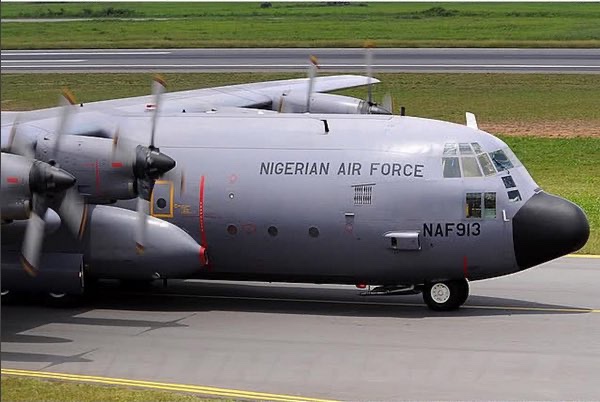
NAF C-130 Makes Emergency Landing in Burkina Faso After Mid-Air Technical Scare
The Nigerian Air Force has moved swiftly to calm rising public speculation after a NAF C-130 Hercules aircraft made an unexpected diversion and precautionary landing in Burkina Faso during a ferry mission to Portugal on 8 December 2025. The episode, which briefly sparked online panic and fueled a wave of
The Nigerian Air Force has moved swiftly to calm rising public speculation after a NAF C-130 Hercules aircraft made an unexpected diversion and precautionary landing in Burkina Faso during a ferry mission to Portugal on 8 December 2025. The episode, which briefly sparked online panic and fueled a wave of misinformation across social media platforms, has now been clarified by NAF authorities, who insist the maneuver was a textbook safety response and not the result of any hostile encounter or catastrophic failure as widely assumed.
According to an official statement signed by Air Commodore Ehimen Ejodame, Director of Public Relations and Information, the aircraft had departed Lagos as scheduled before the crew detected what was described as a “technical concern” mid-flight. Although NAF did not publicly disclose the specific nature of the issue, the crew reportedly followed strict international aviation protocols by diverting to the closest airfield—Bobo-Dioulasso in Burkina Faso—rather than risk continuing the journey to Europe with a potential fault onboard. The transparency of the report has been widely praised as an example of responsible communication amid rising anxieties surrounding military aviation incidents.
Eyewitness accounts from Burkina Faso\'s regional airport authorities confirm that the aircraft touched down safely and without chaos. Passengers and military personnel onboard were immediately received and assisted by host officials, who reportedly extended warm hospitality to the Nigerian crew pending further technical assessment of the aircraft. NAF emphasizes that no lives were in danger at any point, and the decision to land was purely precautionary—a move aligned with global aviation best practices that prioritize human life and equipment safety above all else.
In recent years, military aircraft movements have attracted increased public scrutiny in Nigeria, particularly amid concerns over operational readiness, fleet maintenance, and the demanding workload placed on air assets involved in national security operations. The C-130 Hercules, one of the Air Force’s most versatile and iconic transport aircraft, has long served as a backbone of logistics missions, humanitarian operations, and troop deployment. Any report involving the aircraft naturally triggers heightened interest. The latest incident, therefore, quickly became a trending topic online, with speculative theories circulating even before the Air Force released its official communication.
However, NAF’s immediate clarification appeared to neutralize the viral tension. The detailed statement from Air Commodore Ejodame reassured Nigerians that the crew was not only safe but received “cordial treatment” from Burkina Faso authorities. Local aviation officials in Burkina Faso echoed this sentiment, describing the landing as professionally handled and in full conformity with standard protocols. Analysts say such cooperation underscores the strong diplomatic and military partnerships across West African nations, where shared air routes and emergency protocols are critical for regional safety and operational success.
The Air Force’s message also highlighted that plans are underway to resume the mission to Portugal as originally scheduled. Aircraft engineers are currently conducting assessments and corrective actions needed to clear the aircraft for continued flight. While the exact timeline for departure is yet to be announced, the tone of the statement strongly suggests no major crisis or long-term setback.
Military aviation experts note that precautionary landings are not unusual, especially for transport aircraft traveling long distances across international borders. The C-130, though known for its rugged reliability, still operates under strict safety regulations that compel pilots to err on the side of caution at the slightest indication of a fault. This culture of safety, the statement underscores, remains foundational to the Nigerian Air Force’s operations. By taking timely action, the crew not only protected themselves but also safeguarded an important national asset.
NAF has faced its share of operational controversies in recent years, with public concerns ranging from accidental airstrikes to aircraft fatigue related to prolonged counter-terrorism deployments. The Air Force appears keen on rebuilding confidence by demonstrating professionalism, transparency, and an unwavering commitment to adherence to global aviation standards. The latest communication reinforces this posture, signaling a leadership that understands the importance of public trust in shaping narratives around the military’s activities.
Furthermore, the assured tone of the Air Force’s message suggests an internal confidence in its maintenance culture and crisis-response systems. While technical issues can never be completely eliminated, especially in aging fleets, what matters most is the nature of the response—and in this case, NAF’s actions appear to align with the highest safety benchmarks. The swift landing, thorough evaluation, and structured plan to resume the mission demonstrate a disciplined approach to risk management.
For many Nigerians, the key takeaway is that the crew is safe and the situation was handled without drama. At a time when the nation grapples with multiple security and governance challenges, news of professionalism within the military often provides a rare moment of reassurance. Some aviation commentators have also suggested that the incident offers an opportunity for the Air Force to further strengthen its public communication frameworks, ensuring that misinformation does not fill the vacuum when unexpected events occur.
Meanwhile, Burkina Faso’s cooperation has drawn commendation from observers who view such gestures as a sign of regional solidarity. Emergency landings can be sensitive situations, especially involving military aircraft, but the courteous handling of the Nigerian crew reinforces mutual respect among neighboring states sharing both airspace and security responsibilities.
As the C-130 undergoes final evaluations before continuing its journey, Nigerians can expect more updates from NAF in the coming hours or days. The Air Force has pledged continued transparency and reiterated its dedication to protecting its personnel while fulfilling its constitutional mandate. The message concludes with gratitude toward the public and partner authorities for the support extended during the period of the diversion.
What began as a moment of uncertainty has now become a demonstration of procedural precision, regional cooperation, and military accountability. And in a time of heightened sensitivity to aviation incidents, the Nigerian Air Force’s response offers a subtle reminder that professionalism remains alive within the ranks, guiding every decision from takeoff to landing—even when the journey takes an unexpected turn.
Share this post
Related Posts

Nigerian Visa Applicants Now Required to Submit Five Years of Social Media History
A new layer of scrutiny has been introduced into Nigeria’s visa process, with applicants now...

Joy Multiplies as Comedian Lasisi Elenu and Wife Nonso Expect Second Child, Making Rain a Big Sister
Popular Nigerian comedian and skit maker Lasisi Elenu has once again warmed the hearts of...
Flowers on the Surface, Fire Beneath: Nigerien Forces Foil Daring 200kg Explosives Smuggling Plot from Nigeria
Nigerien security forces on Tuesday dealt a significant blow to cross-border criminal networks after intercepting...