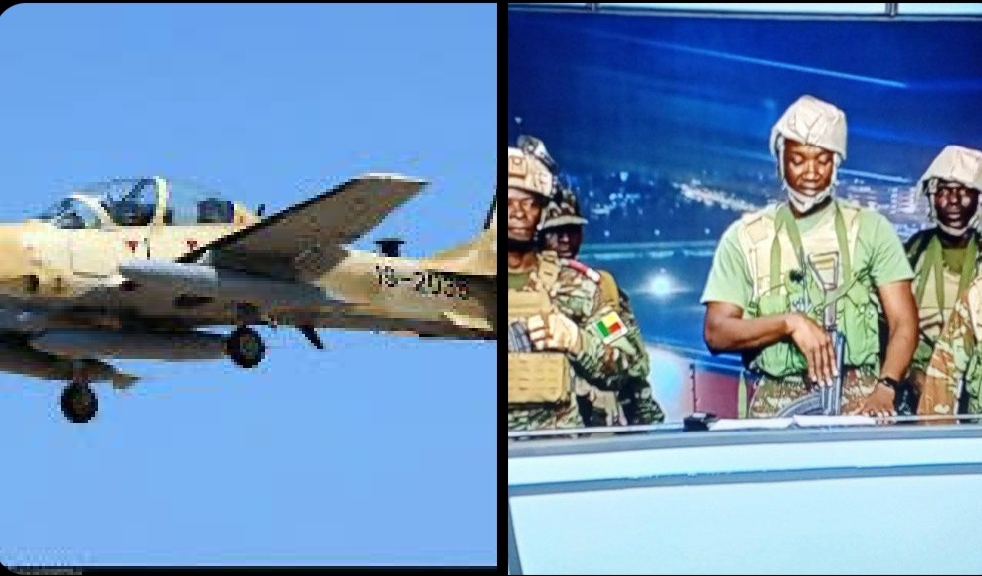
Tension gripped West Africa on Sunday as Nigerian fighter jets were reportedly dispatched into the airspace of neighboring Benin Republic following what security sources described as a sudden military takeover that ousted President Patrice Talon from power.
The unexpected development sent shockwaves through regional diplomatic and security circles, immediately raising fears of instability spreading across an already fragile subregion grappling with coups, insurgency, and geopolitical uncertainty.
According to multiple credible security sources, the Nigerian military aircraft departed from Lagos on Sunday and were later observed flying over strategic locations within Benin Republic’s airspace. While official authorities in Abuja have maintained silence on the exact scope and intent of the deployment, it is understood that Nigeria has significantly heightened its surveillance operations to closely monitor the fast-evolving political and security situation across its western border.
The reported takeover in Benin Republic marks a dramatic escalation in West Africa’s long-running struggle with unconstitutional changes of government. Over the past several years, military coups have ripped through Mali, Guinea, Burkina Faso, and Niger, weakening democratic institutions and straining relations with regional powers and international partners. The possibility that Benin, long seen as one of the region’s more stable democracies, could now be slipping into similar turmoil has triggered intense concern in Abuja.
Security analysts say Nigeria’s rapid aerial response reflects both strategic caution and regional responsibility. As Africa’s most populous nation and one of ECOWAS’ dominant military powers, Nigeria has often taken the lead in imposing diplomatic pressure, coordinating sanctions, and threatening military intervention whenever democracy is overthrown in the subregion. The presence of fighter jets over Benin’s airspace signals that Abuja is taking no chances, especially with the country’s western security corridor now potentially exposed to new risks.
The stakes are high. Benin Republic shares a long and porous border with Nigeria, and any prolonged political instability could quickly translate into cross-border crime, refugee movements, arms trafficking, and terrorist infiltration. With Nigeria already battling insurgency in the North-East, banditry in the North-West, and secessionist unrest in the South-East, another unstable neighbor threatens to stretch security resources dangerously thin.
Sources within the security architecture suggest that the Nigerian Air Force deployment is primarily focused on intelligence gathering, aerial surveillance, and deterrence rather than immediate combat engagement. The goal, insiders say, is to maintain a real-time picture of troop movements, secure Nigeria’s borders from sudden spillover threats, and position the country for rapid response should ECOWAS decide on collective action.
The alleged ouster of President Patrice Talon has already triggered frantic diplomatic back-channel communications across West Africa. Regional leaders are said to be scrambling to verify the true status of power in Cotonou, assess the loyalty of Benin’s armed forces, and determine whether negotiations, sanctions, or military pressure will be required. For now, confusion reigns as official statements remain limited and tightly controlled.
On social media, reports of Nigerian jets flying into Benin’s airspace sparked widespread reactions, with many Nigerians expressing a mix of fear, pride, and anxiety. Some praised the swift military posture as proof that Nigeria is serious about defending democracy and regional stability. Others warned that direct military involvement could drag the country into another prolonged and expensive foreign engagement at a time when internal security challenges are already overwhelming.
This unfolding situation also revives memories of Nigeria’s past regional interventions, particularly in Liberia and Sierra Leone during the 1990s under the ECOWAS Monitoring Group. Those missions, though ultimately credited with restoring relative peace, came at a huge economic and human cost. Many Nigerians still debate whether the country can afford to assume a similar leadership role again amid its current economic struggles, rising debt burden, and deep domestic insecurity.
The implications for Benin Republic itself are equally grave. A military takeover would represent a sharp break from years of relative democratic continuity and institutional reforms. Investors, foreign partners, and international development agencies are closely watching events, aware that political instability could trigger capital flight, economic stagnation, and diplomatic isolation almost overnight.
Within hours of the reports, speculation spread that key ports, military bases, and communication infrastructure in Benin had been placed under heavy guard as the balance of power shifted. Flights were reportedly delayed, and residents in parts of Cotonou described unusual troop movements and heightened security presence. None of these claims have been officially confirmed, but they reflect the atmosphere of uncertainty now hanging over the country.
Nigeria’s intensified surveillance posture suggests that Abuja is preparing for multiple scenarios. If the takeover consolidates quickly, diplomatic pressure and coordinated regional condemnation may follow. If it fractures into internal resistance or factional fighting, the risk of mass displacement and humanitarian crisis could rise sharply, especially along Nigeria’s western border communities that have deep economic and social ties with Benin.
There is also the wider geopolitical dimension. West Africa has increasingly become a battlefield for global influence, with competing interests from Western nations, Russia, and other emerging powers shaping alignment decisions after coups. Any shift in Benin’s political direction could alter security partnerships, intelligence cooperation, and military access in a way that affects not just Nigeria but the entire Gulf of Guinea.
For now, the Nigerian government has not issued a formal statement confirming or denying the deployment of fighter jets. That silence has only fueled speculation and heightened public anxiety. Security experts note that in moments like this, careful communication becomes just as critical as military readiness, as misinformation can spark panic or provoke unintended escalation.
What remains undeniable is that the region stands at a delicate crossroads once again. Another successful military takeover in West Africa would further weaken democratic norms and embolden coup plotters elsewhere. Nigeria’s swift airborne response, whether symbolic or strategic, has sent a clear message that the subregion’s largest power is watching closely and is prepared to act if necessary.
As night fell on Sunday and reports continued to trickle in from Cotonou, the air over Benin Republic remained tense with uncertainty. Fighter jets, silent diplomacy, and restless citizens now form part of a drama that could redefine regional politics in the days ahead.
Whether this moment ends in negotiated stability, hardened military rule, or wider confrontation is still unclear. But one thing is already certain — West Africa has once again been thrust into a dangerous chapter where power, fear, and force are colliding at breath-taking speed.
Popular Posts

Korra Obidi Sets Social Media on Fire After Twerking Inside Seun Kuti’s Unfinished Lagos Mansion
07 Dec, 2025
“My Journey Toward Peace Began With You” — Regina Daniels’ Heartfelt Birthday Tribute to Brother Sammy West Melts Fans Across Nigeria
07 Dec, 2025
Tears in the Ashes: Elderly Benue Farmer Weeps as Fulani Herdsmen Attack Claims His Family and Livelihood
07 Dec, 2025Scroll to Top