Seyi Tinubu Under Fire as Wole Soyinka’s Poetic Rebuke Sparks National Debate
Nigeria’s political and social spaces erupted on Wednesday as Nobel Laureate Professor Wole Soyinka delivered one of his most stinging public criticisms of the Tinubu administration—an intervention that has now pushed Seyi Tinubu to the peak of national trends. The remarks, made at the Investigative Journalism Awards in Lagos, were
Nigeria’s political and social spaces erupted on Wednesday as Nobel Laureate Professor Wole Soyinka delivered one of his most stinging public criticisms of the Tinubu administration—an intervention that has now pushed Seyi Tinubu to the peak of national trends. The remarks, made at the Investigative Journalism Awards in Lagos, were wrapped in Soyinka’s trademark poetic sarcasm, but their message was unmistakable: Nigeria has entered an era where the President’s son allegedly moves with enough security to “quash a coup,” and Soyinka believes the absurdity has reached its peak.
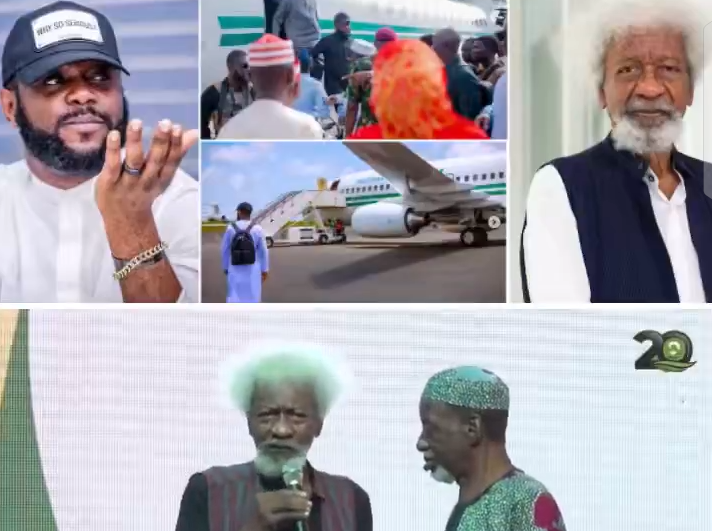
According to Soyinka, the trigger for his rebuke came during an encounter in Ikoyi. He narrated how he stepped out of a hotel one day and saw a massive crowd and heavy security presence. For a moment, he said, he assumed a film was being shot—only to learn that the elaborate scene was not Nollywood at work, but the convoy of Seyi Tinubu. The convoy, he noted, was so intimidating in scale that any unsuspecting bystander could mistake it for a presidential movement, or worse, the staging of an armed takeover.
Speaking on stage in Lagos, Soyinka directly addressed the excesses: the number of officers, SWAT operatives, soldiers and DSS personnel assigned to escort just one man—simply because he happens to be the President’s son. The convoy, he argued, is large enough “to stage a coup in any state,” yet its sole mission is to ferry Seyi through Lagos traffic. It was this revelation that fueled Soyinka’s most biting suggestion: if another coup or insurgency arises in the region, President Bola Ahmed Tinubu should send Seyi—along with the battalion already escorting him—to Benin Republic to suppress it. After all, if that force is strong enough to shake a state, Soyinka implied, it should be strong enough to defend one.
The literary icon went on to remind the audience that Tinubu is not Nigeria’s first president and Seyi is not the first child of a head of state. Yet, according to Soyinka, no previous presidential offspring has carried themselves with such grandiosity or demanded such intimidating levels of protection. “He should know his place,” Soyinka said pointedly, urging Seyi to conduct himself with modesty rather than travelling with what some witnesses have described as a mini-military parade.
Soyinka also revealed that he attempted to raise concerns privately with the National Security Adviser, Nuhu Ribadu, but received no meaningful response. It was after this silence, he explained, that he chose to speak publicly. His decision, however, drew immediate backlash from loyalists of the administration, some of whom accused him of targeting the President’s family. Many Nigerians who consider Soyinka a national treasure expressed disappointment that he would dare criticize the government at such a delicate political moment.
But the backlash did not silence everyone. Activist and former presidential candidate Omoyele Sowore weighed in, declaring that Soyinka’s observations were not only valid, but long overdue. According to Sowore, Seyi Tinubu is “more powerful than the IGP, DSS, CDS and NSA combined,” a statement he supported with claims that the President’s son operates with levels of impunity unknown in Nigeria’s democratic history.
Sowore and his supporters revived older allegations that have trailed Seyi Tinubu for years. One of the most disturbing surfaced in May 2025 when NANS President Isah Atiku accused Seyi of kidnapping him, torturing him, and recording naked videos of him. Atiku claimed the ordeal began after he refused a ₦100 million bribe to endorse Tinubu’s political agenda in the North. According to him, Seyi allegedly threatened to kill him and “order the IGP to cover it up,” boasting that if the Inspector General of Police refused, he would have him sacked by his father. These allegations were reported fiercely at the time by SaharaReporters, sparking controversy that was never fully resolved.
Beyond the alleged scandals, the issue of Seyi’s convoy has been a national talking point since 2023. Many Nigerians frequently question why the President’s son requires nearly the same level of protection as the President himself. Videos and photos of his movements often go viral, with citizens commenting on the striking resemblance between the two convoys—sometimes only distinguishable by the absence of the official presidential flag.
Speculation about Seyi’s growing political influence has only intensified these concerns. Earlier this year, he was rumored to be the favoured candidate to replace Governor Babajide Sanwo-Olu as the next Governor of Lagos State. Though not officially confirmed, the rumour alone reflected how deeply embedded he has become in Nigeria’s power structure.
One of the earliest major controversies tied to Seyi’s name dates back to October 2023, when he reportedly flew in the Presidential Jet to Kano with a group of friends to watch a polo match. The incident triggered national outrage, as many questioned why the Presidential aircraft—funded by taxpayers—was being used for personal leisure. Upon arrival in Kano, he received what was described as a “Presidential welcome,” complete with grand ceremony and heavy security presence. Critics saw the episode as a clear signal that Seyi was wielding presidential privileges with little regard for protocol or public perception.
These repeated events have created an atmosphere where many Nigerians believe Seyi Tinubu has become an unofficial extension of the presidency, a power centre operating parallel to official channels. Soyinka’s comments only amplified that sentiment, prompting fresh debate on whether Nigeria is drifting into a political culture where family ties supersede constitutional authority.
As the dust continues to rise, Nigerians on social media appear torn between outrage, resignation and dark humour. Many argue that Soyinka merely stated what millions have been whispering for months. Others maintain that criticism of the President’s son is unnecessary and unfair. Regardless of where the public stands, the uproar has made one thing clear: the conversation about power, privilege and accountability in Nigeria is far from over.
For now, Seyi Tinubu’s name dominates the headlines once again, not for an official government role or policy initiative, but for the long shadows cast by his convoy, his controversies, and the literary blow delivered by Nigeria’s most globally celebrated writer. Whether the administration chooses to address these concerns or continues to ignore them remains to be seen, but the country is watching closely—and so is Wole Soyinka.
Share this post
Related Posts
Uproar in Abuja as Protesters Storm National Human Rights Commission Over VeryDarkMan’s Detention
In a powerful show of civic outrage and solidarity, hundreds of protesters flooded the gates...
“The Middle Class Is Now Begging to Survive”— Chimamanda Adichie Cries Out Over Nigeria’s Worsening Hardship
Renowned Nigerian author Chimamanda Ngozi Adichie has raised a passionate alarm over the deteriorating economic...
\"Nigerian Girls Now Selling Their Eggs to Survive\" — X Doctor Raises Alarm Over Disturbing Trend in Universities Amid Harsh Economic Realities
A shocking revelation has emerged on social media, sparking outrage and concern across Nigeria, after...