Burkina Faso Foils Alleged Assassination Plot Against Military Leader Ibrahim Traoré
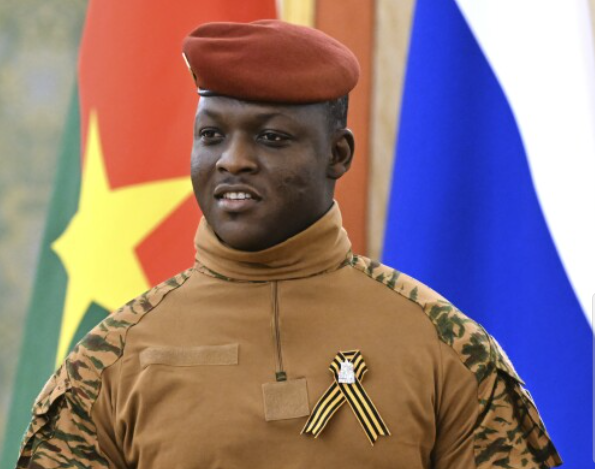
In a dramatic revelation that has sent shockwaves across West Africa, Burkina Faso’s government announced that it successfully thwarted a sophisticated plan to assassinate the country’s military ruler, Captain Ibrahim Traoré. The alleged plot, authorities say, was set to unfold just hours before it was intercepted, highlighting the volatile political
In a dramatic revelation that has sent shockwaves across West Africa, Burkina Faso’s government announced that it successfully thwarted a sophisticated plan to assassinate the country’s military ruler, Captain Ibrahim Traoré. The alleged plot, authorities say, was set to unfold just hours before it was intercepted, highlighting the volatile political climate in a nation that has endured nearly a decade of escalating security crises.
Speaking on national television, Burkina Faso’s Security Minister Mahamadou Sana detailed the chilling nature of the plot, claiming that it had been orchestrated by Lieutenant Colonel Paul Henri Damiba, the former military officer who Traoré overthrew in September 2022. Damiba, once Burkina Faso’s strongman, had been ousted amid widespread discontent over the military’s handling of jihadist insurgencies that have plagued the Sahel region. According to Sana, Damiba allegedly rallied both military personnel and civilian supporters to carry out the operation, going so far as to secure financial backing from abroad, including an estimated $125,000 from neighboring Ivory Coast.
The minister revealed that intelligence services had obtained a leaked video of the conspirators discussing their plans in explicit detail. Sana described the footage as a \"blueprint for chaos,\" showing conversations about two potential methods for eliminating Traoré: a close-range attack or a detonation of explosives at the military leader’s residence, scheduled for just after 11 p.m. on Saturday, January 3rd. Beyond Traoré, the plot allegedly targeted additional military and civilian officials, suggesting a broader attempt to destabilize the government and create political upheaval.
Sana also claimed that the conspirators had considered measures to cripple the country’s defensive capabilities, including attempts to disable Burkina Faso’s drone operations, which are integral to monitoring jihadist movements and preventing external interference. “We are conducting ongoing investigations and have made several arrests. These individuals will face justice soon,” he said, without specifying the number of people detained. The minister reassured citizens that the situation remains under control and cautioned the public against being drawn into \"dangerous schemes,\" signaling the government’s intent to maintain order amid rising tensions.
The revelation comes against the backdrop of an already tumultuous period for Burkina Faso. Since seizing power, 37-year-old Traoré has survived at least two prior coup attempts, navigating a complex web of internal military rivalries while contending with escalating jihadist violence that has displaced millions and destabilized local economies. His tenure has been marked by a heavy-handed approach to governance, yet he retains considerable support domestically, especially among those who view him as a strong figure capable of confronting both internal dissent and external threats.
Traoré’s leadership style has earned him recognition across the African continent, particularly for his outspoken pan-African stance and his criticism of Western influence in the region. While his approach has been controversial, it has resonated with many citizens and regional leaders who perceive him as an assertive voice defending African sovereignty amid foreign intervention and ongoing security challenges. The thwarted assassination attempt underscores the precariousness of his position and the persistent risks that military leaders face in a nation still grappling with political instability and militant insurgencies.
Analysts suggest that the alleged involvement of Damiba, if confirmed, reflects the lingering divisions within Burkina Faso’s military establishment. Damiba’s removal in 2022 had already exposed deep fissures among military factions, some of whom reportedly remained loyal to the ousted leader. The claim that external financing from Ivory Coast played a role in the alleged plot adds another layer of complexity, raising questions about regional politics and the potential influence of neighboring states in Burkina Faso’s internal affairs. Neither Damiba nor Ivorian authorities have responded to the accusations, leaving many unanswered questions about the veracity of the claims and the full scope of the conspiracy.
Security experts note that Burkina Faso’s current predicament is emblematic of a wider pattern across the Sahel, where fragile governance structures, weak institutions, and extremist threats create fertile ground for plots against political leaders. The country’s intelligence services appear to have acted with remarkable efficiency in intercepting the assassination plan, signaling a degree of operational capability that could help maintain stability despite the persistent threats. Nonetheless, the announcement of such a plot is likely to exacerbate anxieties among the population, already burdened by widespread displacement, poverty, and ongoing jihadist attacks.
Traoré’s ability to survive multiple attempts on his life has, paradoxically, enhanced his image both domestically and abroad. For his supporters, his resilience represents strength and determination in the face of existential threats. Yet for critics, the constant emergence of conspiracies underscores the fragility of his government and the deep mistrust that lingers within Burkina Faso’s military ranks. The latest incident is likely to prompt increased security measures and potentially harsher crackdowns on dissent, as the government seeks to deter further attempts on its leadership.
The timing of the alleged plot—occurring just over three years after Burkina Faso experienced a surge of coups and counter-coups—highlights the ongoing volatility in a country where political transitions are often unpredictable and fraught with risk. It also underscores the challenges facing African nations where military coups and insurgent violence intersect with regional power struggles and external influence. Traoré’s position remains delicate, balancing the need to maintain authority while projecting stability to both citizens and international observers.
Despite these challenges, Traoré has continued to consolidate power, demonstrating an ability to navigate a treacherous political landscape. His approach, characterized by direct engagement with security forces and assertive public messaging, appears designed to both deter opposition and reassure allies of his command. The thwarted assassination plot, while alarming, may ultimately serve to reinforce his standing, portraying him as a leader capable of surviving internal threats and maintaining governance under extreme pressure.
The coming weeks are likely to see heightened vigilance within Burkina Faso’s security apparatus, with further investigations expected to uncover additional details about the alleged plot and its backers. The government’s response will be closely monitored, as any misstep could inflame tensions or embolden opponents. Meanwhile, ordinary citizens continue to navigate life amid ongoing insecurity, uncertain of what each new development might bring in a nation where political conspiracies and armed threats have become an almost routine concern.
In a region defined by instability, Traoré’s survival amid multiple coup attempts and assassination plots positions him as both a symbol of resilience and a focal point of controversy. The announcement that an assassination plan was disrupted just hours before it was scheduled to occur serves as a stark reminder of the fragile balance of power in Burkina Faso and the persistent dangers that confront those who seek to govern in one of Africa’s most tumultuous countries. As investigations continue and the government tightens security measures, all eyes will remain on Traoré, whose leadership will once again be tested in the coming months amid a landscape fraught with political intrigue, regional tensions, and security threats that show no sign of abating.
The events surrounding this foiled plot underscore the fragile intersection of politics, military loyalty, and regional influence in Burkina Faso. For now, the nation breathes a cautious sigh of relief, while the shadow of past and potential future conspiracies lingers, a reminder that in the Sahel, power is often measured not only by authority, but by survival in a landscape where threats can emerge at any moment
Share this post
Related Posts
Global Collaboration Takes Center Stage as IGP Egbetokun Engages World Police Leaders
The World Police Summit in Dubai, United Arab Emirates, came to a remarkable close on...
BREAKING: Buhari Had No Home in London, Relied on Friends for Bills – Femi Adesina Reveals
In a revelation that has stirred both admiration and curiosity, former presidential spokesperson Femi Adesina...

Uche Montana Stuns Fans as She Splashes Millions on a 2025 Range Rover
Nollywood actress Uche Montana has once again proven that hard work pays off in style...