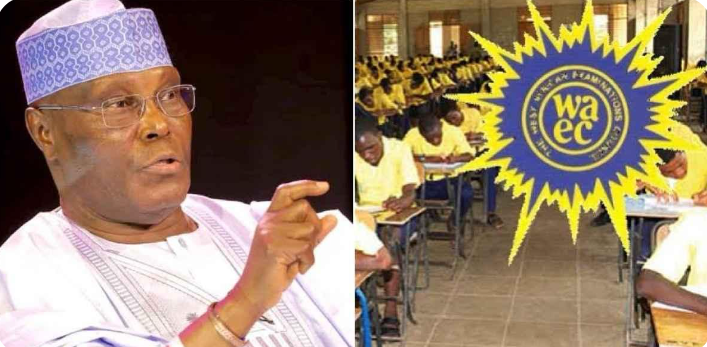
In the Dark: Atiku Slams WAEC Exam Chaos as ‘National Disgrace’
In a country with one of the largest populations of young people in the world, the news that Nigerian students were forced to write their West African Senior School Certificate Examinations (WASSCE) in total darkness has sparked a fierce national outcry—and rightly so. Former Vice President Atiku Abubakar minced no
In a country with one of the largest populations of young people in the world, the news that Nigerian students were forced to write their West African Senior School Certificate Examinations (WASSCE) in total darkness has sparked a fierce national outcry—and rightly so. Former Vice President Atiku Abubakar minced no words as he condemned the situation, calling it a “national disgrace” and a glaring reflection of the deep rot in the nation’s public education system.
The incident, which came to light through videos and firsthand reports from students across various exam centers, has horrified millions. Social media has been flooded with images of teenagers squinting through question papers using flashlights and the glow of their mobile phones. In a country that aspires to global competitiveness, this disturbing reality has left many Nigerians asking: how did we get here?
Atiku Abubakar’s response was swift and scathing. He described the scenario as \"unacceptable, unjustifiable, and utterly indefensible,\" lamenting the sorry state of Nigeria’s educational infrastructure in 2025. His statement was more than political commentary—it was a call to national conscience. “Our children are being treated like second-class citizens,” he said, emphasizing that these examinations are not just academic exercises but pivotal moments that can shape a student’s entire future.
The issue has also drawn the ire of Nigeria’s lawmakers. The House of Representatives Committee on Basic Education and Examination Bodies issued a 24-hour ultimatum to the West African Examinations Council (WAEC), demanding an immediate explanation. Committee Chairman Oboku Oforji made it clear that this is not the first time WAEC had been invited to clarify operational shortcomings and ignored the call. This time, lawmakers are under pressure from the public, and failure to act decisively could further erode trust in both educational and legislative institutions.
As outrage continues to spread, the National Association of Nigerian Students (NANS) joined the chorus of condemnation. The student body slammed WAEC for the delay in conducting the English Language exam—a core subject that determines eligibility for many university admissions. For students who have spent years preparing for these high-stakes exams, the chaos and mismanagement surrounding the process feel like a betrayal.
Atiku didn’t stop at criticism. He offered a concrete demand: that all compromised exams be retaken at the affected centers. “Examination preparedness is a shared responsibility between students and examination authorities,” he said. “In this case, the latter has failed spectacularly.” The former Vice President warned that failing to retake the exams would amount to robbing students of their rightful futures—a stance that many parents and educators have echoed.
What makes this situation even more damning is that it didn’t come out of nowhere. Nigeria’s power infrastructure has been in shambles for decades. Blackouts are common, and schools—especially in rural or underfunded areas—routinely lack basic amenities like electricity, water, and even chairs. Yet, every year, WAEC and other examination bodies schedule exams with the assumption that conditions will somehow be miraculously different.
Why is it, Atiku and many others are asking, that no contingency plans were in place? Why are generators not mandated in all WAEC centers? Why is there no system of accreditation that ensures a minimum standard for hosting examinations of such national importance?
These questions cut to the core of what many now see as an institutional rot that goes beyond WAEC. It is a mirror reflecting the wider dysfunction in Nigeria’s public service systems—from education and healthcare to infrastructure and energy. The tragedy, in this case, is that it is the youth—bright, ambitious, and blameless—who are forced to bear the consequences.
In many ways, this incident has become a symbol of the broader crisis facing Nigeria. It’s not just about darkness during exams. It’s about a nation fumbling in the dark—literally and metaphorically—when it comes to planning for its future. Education is supposed to be the great equalizer, a ladder out of poverty, a pathway to empowerment. But what happens when that very ladder is broken?
Atiku’s intervention has thrown the spotlight on a crisis that has, for too long, been swept under the carpet. His voice, amplified by his status as a former Vice President and perennial presidential contender, has ensured that this will not be another scandal that fades quietly. His demand for immediate action and lasting reforms has set the tone for what could become a national reckoning with the state of education in Nigeria.
Even more critically, he has pushed the conversation beyond finger-pointing. “Going forward,” he said, “it is imperative that relevant authorities establish and enforce minimum environmental and infrastructural standards for all high-stakes national examinations.” This is not just about punishing WAEC; it’s about building a resilient and equitable educational system that prepares Nigerian youth for the future—not one that punishes them for the failures of the present.
The coming days will be crucial. WAEC is expected to appear before the House of Representatives to explain itself. The public will be watching closely—not just to see who gets blamed, but to find out whether Nigeria will finally take meaningful steps to ensure that such a disgrace never repeats itself. The demand is simple: competence, accountability, and justice for the students.
For now, the students who wrote their exams in darkness are left with more than unanswered questions. They’re left with anxiety, uncertainty, and a profound sense of neglect. In a country that routinely celebrates its young achievers abroad, how is it that the same country fails to provide basic exam conditions at home?
The answer to that question may determine whether Nigeria’s future truly lies in the hands of its youth—or whether it remains stuck in the shadows of systemic failure. One thing is clear: the darkness that enveloped those exam halls wasn’t just a power outage—it was a damning metaphor for a nation failing its next generation.
Share this post
Related Posts

OdumoduBlvck Reveals Why Davido Gifted His Girlfriend ₦10M
Popular Nigerian rapper OdumoduBlvck has opened up about the unexpected and generous gesture from Afrobeat...

She Chose the Wig: Viral Story of a Husband’s Birthday Dilemma Sparks Debate Across Social Media
A lighthearted but thought-provoking conversation took over social media after an X user, @YoriOlajide, shared...
Terry G Confesses: ‘I Serve the Devil — He Made Me Successful’ — Fans in Total Shock as Singer Clears the Air After Death Rumours
The internet has once again been thrown into chaos following a shocking revelation by Nigerian...