INEC Rejects Petition to Recall Senator Natasha Akpoti-Uduaghan, Citing Constitutional Gaps
The Independent National Electoral Commission (INEC) has dismissed the petition seeking to recall Senator Natasha Akpoti-Uduaghan, representing Kogi Central Senatorial District, citing failure to meet constitutional requirements. The commission’s decision has sparked reactions from political observers and stakeholders within the state and beyond.INEC made its stance clear in an official
The Independent National Electoral Commission (INEC) has dismissed the petition seeking to recall Senator Natasha Akpoti-Uduaghan, representing Kogi Central Senatorial District, citing failure to meet constitutional requirements. The commission’s decision has sparked reactions from political observers and stakeholders within the state and beyond.
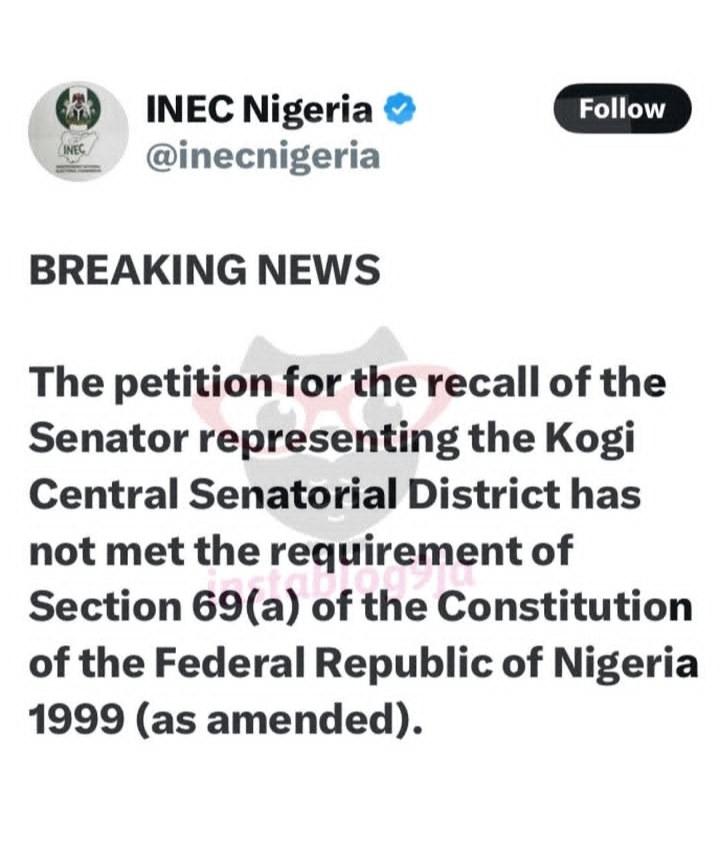
INEC made its stance clear in an official statement released on its X (formerly Twitter) handle on Thursday. The electoral body asserted that the petition did not fulfill the necessary conditions stipulated in Section 69(a) of the Constitution of the Federal Republic of Nigeria 1999 (as amended), which outlines the legal framework for the recall of a legislator.
“The petition for the recall of the Senator representing the Kogi Central Senatorial District has not met the requirement of Section 69(a) of the Constitution of the Federal Republic of Nigeria 1999 (as amended),” INEC stated unequivocally.
The move to recall Senator Akpoti-Uduaghan has been a subject of political discourse in recent months, with opposing factions within Kogi Central pushing for her removal. The petitioners, reportedly led by certain political interest groups, alleged non-performance and misrepresentation as grounds for their recall attempt. However, their efforts have now hit a legal roadblock, as INEC’s decision effectively halts the process at this stage.
Under Nigerian law, the process of recalling a senator is rigorous and requires the petition to be signed by at least half of the registered voters in the affected senatorial district. Additionally, a referendum must be conducted, where a majority of voters must approve the recall before INEC can proceed with further actions. INEC’s rejection indicates that these fundamental prerequisites were not met.
The commission’s decision has drawn mixed reactions from different quarters. Supporters of Senator Akpoti-Uduaghan have hailed the development as a victory for democracy and due process, accusing her political opponents of attempting to subvert the will of the people through unconstitutional means. Many of her loyalists have taken to social media to celebrate the ruling, calling it a testament to the senator’s legitimacy and popularity within Kogi Central.
On the other hand, those pushing for her recall have expressed disappointment and frustration over INEC’s stance. Some opposition voices argue that the commission’s interpretation of the constitutional provisions is too rigid and discourages voter participation in holding elected officials accountable. They insist that the petition had significant backing and should have been allowed to progress to the next stage of the recall process.
Senator Natasha Akpoti-Uduaghan has yet to issue an official statement in response to INEC’s announcement, but sources close to her camp suggest that she remains focused on her legislative duties and is committed to delivering on her promises to the people of Kogi Central. The senator, known for her advocacy on good governance and development, has maintained a strong presence in the political landscape since assuming office.
Political analysts view INEC’s rejection of the recall petition as a significant moment in Nigeria’s democratic process, highlighting the challenges associated with recalling elected representatives. Some have pointed out that the high constitutional thresholds for recall make it almost impossible to remove a sitting legislator, arguing that the process needs reform to enhance accountability while ensuring fairness.
In recent years, there have been very few successful recall attempts in Nigeria, with most petitions failing to meet the stringent requirements set by the constitution. The difficulty of recalling lawmakers has led to debates on whether the current legal framework sufficiently empowers constituents to demand accountability from their representatives.
The rejection of the recall petition against Senator Akpoti-Uduaghan is likely to have political ramifications within Kogi Central and beyond. It reinforces the perception that recall mechanisms, while theoretically available, are practically unachievable under the present constitutional provisions. The development may also embolden other lawmakers facing similar threats of recall to be more assertive in their positions, knowing the legal hurdles their opponents must overcome.
For now, the controversy surrounding the recall attempt appears to have been put to rest by INEC’s decision. However, the political landscape in Kogi Central remains dynamic, and it is yet to be seen how this outcome will shape future political engagements in the senatorial district. As the dust settles, one thing remains clear: the road to recalling a senator in Nigeria is steep, and any attempt to do so must be backed by overwhelming constitutional compliance to stand a chance of success.
Share this post
Related Posts

A Gift Wrapped in Love: Man’s Wife Surprises Him with Brand-New iPad After Casual Remark
In a heartwarming tale that has captured the attention of thousands on social media, a...

BREAKING: Actor Julian McMahon Passes Away at 56 After Private Cancer Battle
Hollywood is mourning the loss of one of its most charismatic stars. Julian McMahon, the...

Kaduna Kidnapper Hideout Stormed: Nigerian Army Neutralises One Suspect in Dramatic Raid
In a decisive operation that underscores the Nigerian Army’s commitment to ending the menace of...