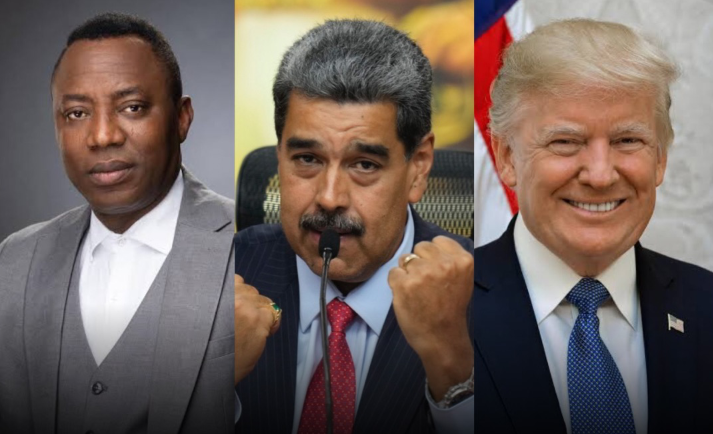
Sowore Demands UN Dissolution Amid U.S. Military Action in Venezuela
Nigerian activist and political commentator Omoyele Sowore has issued a scathing critique of the United Nations, calling for its outright dissolution in the wake of recent U.S. military operations in Venezuela. His comments, posted on X.com, directly linked the international body’s failures to what he described as “illegal regime change”
Nigerian activist and political commentator Omoyele Sowore has issued a scathing critique of the United Nations, calling for its outright dissolution in the wake of recent U.S. military operations in Venezuela. His comments, posted on X.com, directly linked the international body’s failures to what he described as “illegal regime change” orchestrated by former U.S. President Donald Trump, which allegedly resulted in the kidnapping of Venezuelan President Nicolás Maduro and his wife. Sowore’s message paints a picture of a global institution he believes has lost its relevance, authority, and moral compass, arguing that the United Nations has become nothing more than a ceremonial platform incapable of checking the ambitions of powerful nations.
In his tweet, Sowore did not mince words. He accused the UN of being “compromised and largely irrelevant,” highlighting its inability to restrain unilateral aggression, war crimes, and other abuses of power by individual states. For Sowore, the organization’s repeated failures expose “a deep and incurable structural rot” that renders it ineffective in fulfilling its founding mandate of safeguarding international peace and security. According to the activist, the UN’s shortcomings are laid bare whenever the actions of a single powerful nation go unchecked, placing the lives of millions at risk.
The catalyst for Sowore’s condemnation appears to be the U.S.’s recent military intervention in Venezuela, a move that critics have described as a direct violation of international law and Venezuelan sovereignty. While official statements from the U.S. government framed the operation as part of broader counterterrorism and security objectives, Sowore framed it as a blatant “regime change agenda” driven by ego and lust for dominance. The alleged capture of President Maduro and his wife has only intensified his call for urgent reform—or in his view, total replacement—of global governance structures.
Sowore’s critique touches on a long-standing debate about the relevance of the United Nations in modern geopolitics. Since its founding in 1945, the UN has often been praised for its peacekeeping missions, humanitarian interventions, and efforts to facilitate multilateral diplomacy. However, critics argue that it has repeatedly failed to prevent conflicts, curb human rights abuses, or hold powerful nations accountable. From the wars in Iraq and Afghanistan to ongoing crises in Myanmar and Ukraine, the UN has faced scrutiny for being slow, ineffectual, or overly cautious when confronting major global powers. Sowore’s remarks echo this frustration, suggesting that the institution’s failures are structural rather than circumstantial.
The activist proposes a radical solution: the dissolution of the United Nations and the formation of a “truly credible coalition of nation-states” designed to serve humanity rather than the interests of a few dominant powers. Such a coalition, in Sowore’s view, would be more effective in preventing tyranny, upholding justice, and protecting the world from the destructive ambitions of individuals or states. While he did not offer a detailed blueprint for such a coalition, his call signals a broader demand for accountability, transparency, and systemic reform in global governance.
Sowore’s statements have drawn widespread attention on social media and have reignited discussions about the effectiveness of international institutions in an era marked by rising unilateralism and geopolitical tensions. Supporters argue that his critique is timely, emphasizing the urgent need for mechanisms that can constrain rogue states and protect smaller nations from coercion or military aggression. Critics, however, contend that dissolving the UN would create a dangerous power vacuum, potentially exacerbating global instability rather than resolving it.
The controversy surrounding U.S. actions in Venezuela has intensified international debates about sovereignty, legality, and the balance of power. Many experts highlight that military interventions by foreign powers, even under the pretext of protecting democracy or national security, carry profound risks, including civilian casualties, political chaos, and regional destabilization. Sowore’s condemnation taps into these fears, framing the U.S. operation as not just a bilateral issue but a failure of global governance to act decisively against aggression.
Analysts suggest that Sowore’s call for dissolving the UN may resonate with populations and nations frustrated by what they perceive as a system tilted in favor of powerful states. Over the years, smaller nations and civil society actors have increasingly criticized the Security Council’s structure, particularly the veto powers held by the five permanent members, arguing that these powers enable unilateral action while limiting collective accountability. Sowore’s message amplifies these longstanding grievances, asserting that a system incapable of holding even the most powerful nations accountable has forfeited its legitimacy.
Despite its flaws, the UN continues to play a role in international peacekeeping, humanitarian aid, and diplomatic mediation. From coordinating responses to climate change to managing refugee crises, the organization still serves as a forum for global cooperation. Yet, as Sowore and others point out, its inability to confront egregious abuses by powerful states undermines both its credibility and its moral authority. This tension—between the UN’s aspirational goals and the practical limits of its influence—remains at the heart of debates about the future of international governance.
Sowore’s critique also raises broader questions about the responsibility of global citizens to demand accountability from international institutions. In an era of interconnected crises, including wars, economic instability, and environmental emergencies, the effectiveness of multilateral institutions is more critical than ever. By calling for a complete overhaul of the UN, Sowore challenges not only policymakers but ordinary citizens to reflect on what mechanisms are truly needed to protect humanity and prevent the concentration of unchecked power.
The call to dissolve the United Nations is radical, controversial, and unlikely to be implemented in the short term. Nonetheless, Sowore’s statements underscore a growing impatience with the status quo and the urgent need for international reform. Whether through restructuring existing institutions, creating alternative coalitions, or strengthening accountability measures, the message is clear: the current system, in Sowore’s view, is incapable of confronting the ambitions of individuals and nations that threaten global peace.
As the world watches the unfolding situation in Venezuela and debates the legality and morality of U.S. military interventions, Sowore’s message will likely continue to spark conversation and debate. His condemnation of both Trump’s actions and the UN’s perceived failures resonates with broader anxieties about the vulnerability of smaller nations in a world dominated by superpowers. It also reflects a persistent desire for a global system that is fair, just, and capable of protecting humanity from the excesses of power.
While opinions on Sowore’s call vary, one thing is certain: his statement has forced renewed scrutiny on the United Nations and its role in an increasingly turbulent world. The question remains whether the international community will heed the warning or continue along a path that critics argue risks legitimizing unchecked power rather than restraining it. In the meantime, the debate about reforming—or even replacing—the UN will continue, fueled by incidents like the Venezuelan crisis and amplified by voices like Sowore’s that demand accountability, justice, and real global leadership.
In conclusion, Omoyele Sowore’s bold call to dissolve the United Nations highlights what he sees as the institution’s chronic failures and structural rot. By connecting these failures to the alleged U.S. military intervention in Venezuela, Sowore challenges the legitimacy of a global body that many believe has lost its moral authority. His proposal for a credible coalition of nations designed to serve humanity reflects growing frustration with the current international order and a desire for systems capable of preventing tyranny and upholding justice. Whether his vision will gain traction or remain a provocative critique, it has undeniably reignited global discussions on the effectiveness, relevance, and future of the United Nations in a world still grappling with power, conflict, and accountability.
Share this post
Related Posts
Senator Ben Bruce Predicts a Global War But Declares Nigeria Will Be Africa’s Safe Haven
In a statement that has left many stunned, intrigued, and divided in opinion, Nigerian senator...

“I Am a Very Secretive Person” — Lilian Afegbai Reveals Why She Keeps Her Relationships and Private Life Off-Limits
Nollywood actress and reality TV star Lilian Afegbai has sparked fresh conversations about boundaries, trust,...
Tension in Abuja as NSA and Service Chiefs Hold Emergency Meeting Following Trump’s Military Intervention Warning
Nigeria’s security architecture was thrust into emergency mode on Monday as the National Security Adviser...