news
Warri–Itakpe Train Derails Again Just Five Days After Service Resumption, Sparks Safety Concerns Nationwide
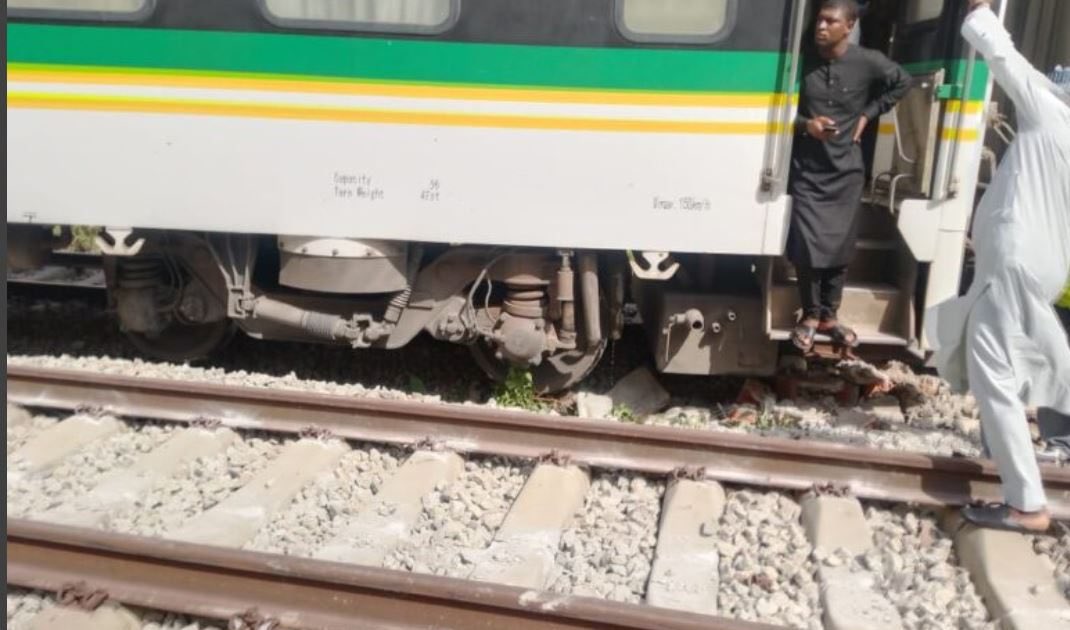
Barely five days after the much-celebrated resumption of service along the Warri–Itakpe railway line, a fresh setback has hit the route as one of the trains derailed on Saturday evening, forcing the Nigeria Railway Corporation (NRC) to suspend all operations pending investigation. The incident, which occurred between Ajaokuta and Itakpe, has once again thrown a spotlight on Nigeria’s rail infrastructure, raising serious concerns about maintenance, safety standards, and government accountability in managing the nation’s transport assets.
According to initial reports, the train was carrying dozens of passengers traveling from Ujevwu Station in Warri, Delta State, to Itakpe in Kogi State when it suddenly went off the tracks. Witnesses described the experience as terrifying, saying the train suddenly lurched sideways before coming to a grinding halt in a cloud of dust. Panic quickly spread through the cabins as passengers scrambled to safety. Though no fatalities have been reported, several passengers were said to have sustained minor injuries, and luggage was scattered in the chaos that followed.
The Nigeria Railway Corporation confirmed the incident in a statement released Sunday morning, noting that services along the route have been temporarily suspended “to allow for proper assessment and repairs.” The agency described the derailment as “unfortunate” and assured the public that it was already working with relevant engineers and safety inspectors to determine the cause of the mishap. The NRC added that passengers affected by the incident have been safely evacuated and would be assisted with alternative transportation.
This derailment comes as a huge embarrassment to the corporation and the federal government, especially considering that the Warri–Itakpe train service had only resumed operations last Monday after months of suspension. The line, often touted as one of Nigeria’s most strategic rail routes, had been shut down earlier this year for routine maintenance and track stabilization works. Many passengers had welcomed the reopening with optimism, seeing it as a sign of renewed government commitment to reviving the country’s railway system. However, this latest development has quickly turned optimism into disappointment, with many Nigerians taking to social media to question the quality of the maintenance work and the safety of the nation’s rail infrastructure.
Videos and photos circulating online showed one of the coaches leaning dangerously to one side, its wheels visibly off the rails. Passengers could be seen standing beside the tracks, some clutching their belongings and looking shaken. “It’s by God’s grace that we are alive,” one passenger said in a video clip posted on X (formerly Twitter). “The train suddenly shook violently, and before we knew it, it had gone off the tracks. People were screaming everywhere. This thing could have been worse.”
The Warri–Itakpe line, which connects Nigeria’s oil-rich South–South region to the mineral-rich North–Central corridor, is a vital economic artery designed to ease the movement of passengers and freight, especially between Delta, Edo, and Kogi states. It is part of a larger vision to integrate Nigeria’s rail network and link it with the upcoming Lagos–Kano standard gauge line. The line’s strategic importance cannot be overstated, as it plays a key role in the transportation of iron ore and other minerals from Itakpe to the Ajaokuta Steel Complex, and onward to the ports in Warri.
But the project has been dogged by delays, funding gaps, and technical challenges since its inception in the 1980s. Though it was finally commissioned for commercial use in 2020, the Warri–Itakpe route has suffered multiple operational setbacks, including security breaches, technical faults, and now repeated derailments. In January 2023, a similar incident occurred when a train on the same line derailed, leaving passengers stranded in a forest for hours before rescue teams arrived. At the time, the NRC promised to improve its safety systems and review maintenance protocols. However, Saturday’s incident suggests that little progress has been made since then.
Transportation analysts have described the derailment as a wake-up call for Nigeria’s rail authorities. According to experts, derailments are often caused by a combination of factors including poor track alignment, worn-out rails, mechanical failure, or excessive speed. The recent heavy rains in parts of the country could also have contributed to track instability, though official investigations will be needed to determine the precise cause. Many industry watchers have called for an independent probe to assess not only the cause of the accident but also the overall integrity of the Warri–Itakpe corridor.
Meanwhile, passengers have expressed frustration over what they describe as “poor communication” from railway officials. Several travelers who were booked for upcoming trips said they received no prior notice before hearing of the suspension through the media. “I was supposed to travel to Warri tomorrow morning,” one passenger lamented. “I bought my ticket online, but now everything is just in limbo. We don’t even know when the train will start running again.” Others urged the NRC to establish a better emergency response system, including real-time updates and support for stranded passengers.
In the aftermath of the derailment, public pressure is mounting on the Ministry of Transportation to take decisive action. Nigerians are demanding that the government conduct a thorough safety audit of all railway lines currently in operation. Civil society groups have also urged the National Assembly to summon the leadership of the NRC for questioning over repeated operational lapses. “It is unacceptable that such incidents keep happening without accountability,” one advocacy group said in a statement. “The government must ensure that our railway system meets international safety standards. We cannot continue to gamble with people’s lives.”
The NRC, on its part, has assured that normal operations will resume only after engineers certify the tracks as safe. In its statement, the corporation expressed gratitude to passengers for their patience and understanding while promising to “work tirelessly to restore service as soon as possible.” However, the public’s confidence in the system appears to have been shaken. Many Nigerians are questioning whether the drive to expand rail operations across the country is being matched by sufficient investment in maintenance and safety oversight.
Saturday’s derailment has rekindled a broader debate about infrastructure reliability in Nigeria. While the government has heavily promoted its rail modernization agenda as a cornerstone of economic development, frequent breakdowns, vandalism, and safety incidents continue to undermine public trust. For many citizens, the promise of a modern, efficient railway system remains elusive.
As investigations into the Warri–Itakpe derailment continue, the incident serves as a sobering reminder that infrastructure expansion must go hand in hand with proper maintenance, safety culture, and accountability. For now, the affected passengers count themselves lucky to have escaped unharmed — but for a nation that has waited decades for a reliable railway network, luck should never be the only safety guarantee.
The NRC’s next steps will be crucial in determining whether the Warri–Itakpe route can regain public confidence or become another symbol of Nigeria’s recurring struggle to sustain critical infrastructure.
Popular Posts

“I Was Having Flashbacks as She Was Kabashing”: Chike’s Candid Confession Sends Waves Through Social Media
06 Dec, 2025
Gospel Artist Victor Thompson’s 5th Wedding Anniversary Photos Spark Praise, Banter, and a Fresh Conversation on ‘Loving Good Things’
06 Dec, 2025
DJ DSF Sparks Debate as She Says It’s Better to Stay in Nigeria Than Do a Job You Hate in the UK
06 Dec, 2025Scroll to Top