news
Bandits Are Nigeria’s Abandoned Children, Not Monsters — Bishop Kukah’s Christmas Message Sparks National Debate
Catholic Bishop of Sokoto Diocese, Matthew Hassan Kukah, has once again stirred deep national reflection with a powerful and controversial message that reframes Nigeria’s worsening insecurity crisis, particularly in the North.
In his 2025 Christmas message, the outspoken cleric described bandits and violent extremists terrorising communities across the country as “children Nigeria failed,” urging citizens and leaders to confront the deeper social collapse that produced them rather than focusing solely on military solutions.
Speaking against the backdrop of relentless attacks, kidnappings, and mass displacement, Bishop Kukah challenged the dominant narrative that paints bandits as irredeemable villains deserving only annihilation.
Instead, he argued that many of those wielding guns in forests and villages today are products of neglect, poverty, illiteracy, and years of leadership failure. According to him, seeing them purely as monsters allows society to escape responsibility for the conditions that gave birth to the violence.
Kukah’s message was not a defence of crime or brutality. He made it clear that the pain of victims remains sacred and undeniable.
However, he insisted that Nigeria’s obsession with force, retaliation, and vengeance has failed to deliver peace because it ignores the broken systems that continue to manufacture violence. In his words, a society that abandons millions of children to ignorance, hunger, and hopelessness should not be shocked when some of them grow into agents of terror.
Drawing from data that highlights the scale of the crisis, Bishop Kukah referenced reports indicating that over 2,000 children have been abducted in Nigeria since the 2014 Chibok schoolgirls’ kidnapping.
He described this figure not just as a statistic but as a tragic symbol of a nation hemorrhaging its future. According to him, each abducted child represents both a victim and a potential recruit into cycles of violence if rescue, rehabilitation, and education are not prioritised.
The bishop rejected calls for purely violent solutions, arguing that guns cannot fix moral decay or social abandonment. He leaned heavily on biblical teachings, particularly the Christian call to redemption, compassion, and moral responsibility.
Kukah maintained that while justice must be served, it must be accompanied by deliberate efforts to rebuild the moral and educational foundations of society. Without this balance, he warned, Nigeria would continue fighting symptoms while the disease spreads unchecked.
In a striking part of his message, Kukah urged Nigerians to ask uncomfortable questions: where were the schools, mentors, parents, institutions, and leaders when these young people were slipping into criminal networks? Where was the state when entire communities were left without education, healthcare, or hope? He argued that banditry did not emerge in a vacuum but thrived in spaces abandoned by governance.
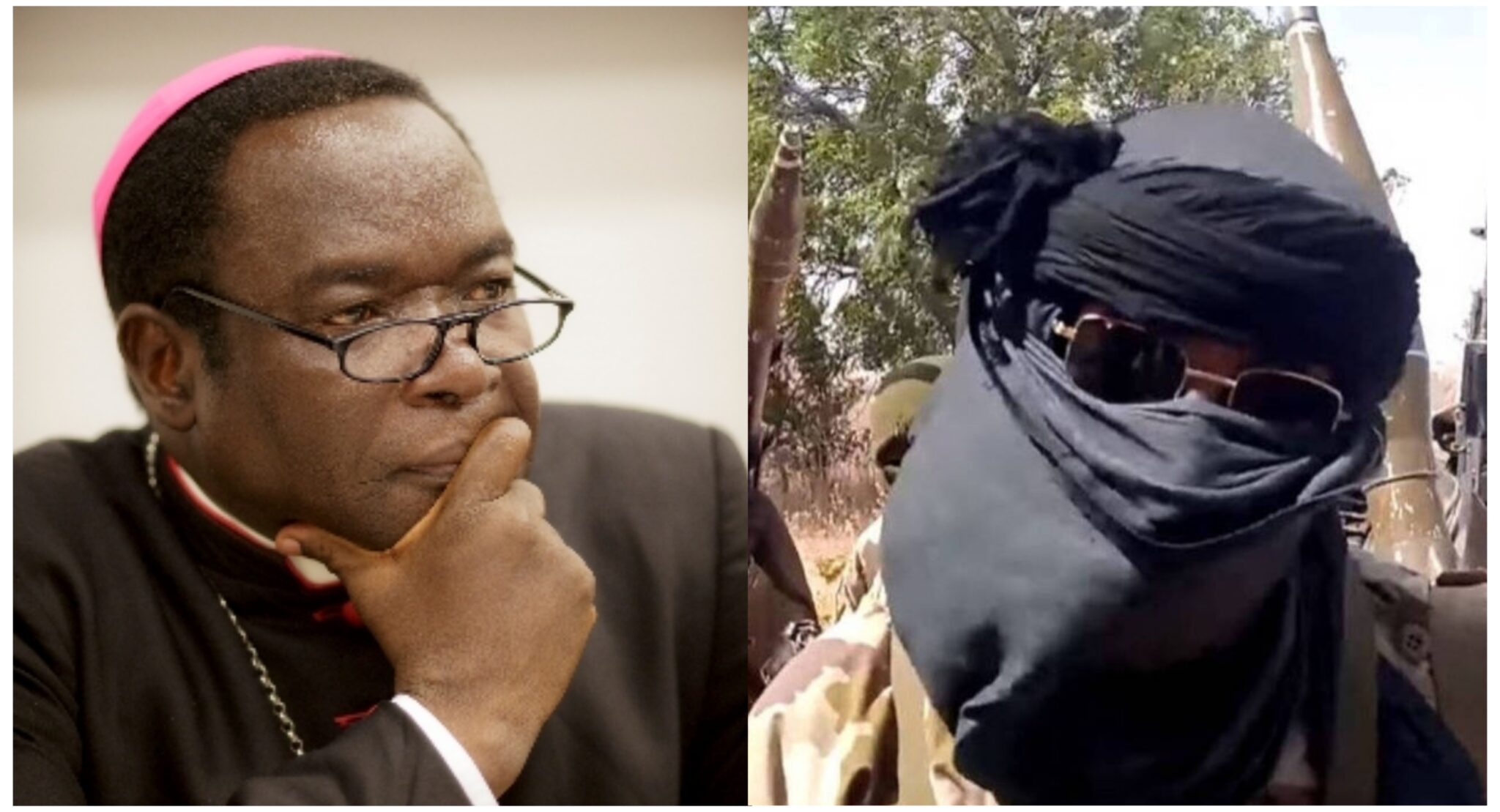
The message was visually reinforced in a widely shared post featuring a split image. On one side was Bishop Kukah’s calm, contemplative portrait, symbolising moral authority and reflection.
On the other was the image of a masked, armed man, representing the violent face of Nigeria’s insecurity. The contrast underscored Kukah’s core argument: behind every gunman is a human story shaped by systemic failure.
Unsurprisingly, the Christmas message ignited intense reactions across social media and public discourse. Supporters praised Kukah for his courage and honesty, describing his words as a rare moral intervention in a country addicted to simplistic solutions.
Many agreed that Nigeria’s failure to invest in education, youth development, and social justice has created a generation vulnerable to radicalisation and crime.
Critics, however, accused the bishop of being insensitive to victims of bandit attacks, kidnappings, and massacres. Some argued that framing criminals as abandoned children risks excusing their actions or diminishing the suffering of families who have lost loved ones. Others insisted that while root causes matter, immediate security threats require decisive military action, not moral philosophy.
Kukah appeared to anticipate such backlash. In his message, he clarified that understanding root causes does not mean tolerating evil. Rather, it is about preventing future violence by cutting off its supply lines. He warned that without aggressive investment in education, job creation, and ethical leadership, Nigeria would simply keep replacing killed bandits with new ones drawn from the same pool of despair.
The bishop’s remarks also reignited broader conversations about leadership accountability. He criticised successive governments for prioritising power struggles and short-term political gains over long-term nation-building. According to him, insecurity is not just a security failure but a moral indictment of leadership that has normalised inequality and neglect.
As Christmas messages go, Kukah’s was far from comforting. Instead of festive platitudes, he delivered a sobering diagnosis of Nigeria’s wounds and an uncomfortable prescription that demands patience, compassion, and systemic reform. His insistence on education as a weapon against extremism resonated strongly, especially in northern Nigeria, where school closures, poverty, and insurgency have combined to rob millions of children of opportunity.
Whether Nigerians agree with Bishop Kukah or not, his message has once again forced the nation to pause and reflect. At a time when anger and fear dominate public conversations about security, he offered a counter-narrative rooted in moral responsibility and long-term thinking. In doing so, he reminded the country that peace is not only enforced with guns but built through justice, education, and the courage to confront uncomfortable truths.
As Nigeria steps into another year burdened by insecurity, Kukah’s Christmas message lingers as both a challenge and a warning: a nation that abandons its children today may end up fighting them tomorrow.
Popular Posts
Heightened Alert in Maiduguri as Borno Police Flood City With Over 1,000 Officers After Deadly Mosque Bombing Ahead of Christmas
25 Dec, 2025
“Taxes for What?” Nigerians Explode as Viral Video Exposes Darkness-Filled Christmas Amid Power Grid Collapse
25 Dec, 2025
Bandits Are Nigeria’s Abandoned Children, Not Monsters — Bishop Kukah’s Christmas Message Sparks National Debate
25 Dec, 2025Scroll to Top