news
Gold, Grief and Public Debate: Prophet Jeremiah Fufeyin’s Lavish Farewell to His 104-Year-Old Mother Sparks Nationwide Reactions
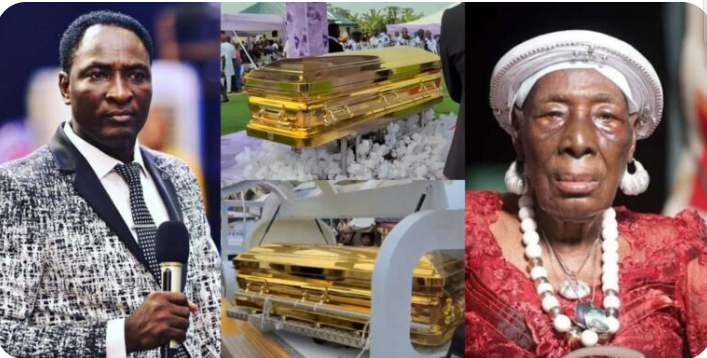
The burial of Mama Asetu, the late mother of popular Nigerian clergyman Prophet Jeremiah Omoto Fufeyin, has ignited widespread conversations across social media and public spaces after reports emerged that she was laid to rest in a gold-plated casket allegedly worth about ₦150 million. The funeral, which took place in December 2025 several months after her passing in May, blended deep emotion, cultural reverence, and conspicuous luxury in a way that has left many Nigerians both impressed and divided.
Mama Asetu, who lived to the remarkable age of 104, was buried in her hometown of Aleibiri in Bayelsa State on Friday, December 12, 2025. The burial followed a funeral service attended by family members, church associates, and well-wishers, creating a solemn atmosphere befitting the matriarch of the Fufeyin family. However, it was not only her long life or the emotional farewell that captured public attention, but the gleaming gold-colored casket that carried her remains to their final resting place.
A video from the burial ceremony soon surfaced online, showing pallbearers carefully lowering the immaculate gold-plated casket into the grave. The footage quickly went viral, drawing admiration, curiosity, skepticism, and criticism in equal measure. Reports accompanying the video claimed that the casket cost over ₦150 million, with some suggesting the price may have exceeded ₦100 million. The striking visual of the coffin instantly became the focal point of the event, overshadowing other aspects of the ceremony.
Prophet Jeremiah Fufeyin, founder of Christ Mercyland Deliverance Ministry, is known for his flamboyant style and high-profile ministry, as well as his significant following across Nigeria and beyond. His decision to give his late mother such an extravagant burial has been interpreted by supporters as an expression of love, honor, and gratitude to a woman who lived a long and fulfilled life. To them, the burial was a celebration of longevity and a son’s ultimate tribute to his mother.
Others, however, have questioned both the reported cost and the symbolism of such an extravagant display in a country grappling with economic hardship, rising inflation, and widespread poverty. Critics argue that the burial reflects the growing gap between wealthy religious leaders and the everyday realities of their followers, many of whom struggle to afford basic necessities. For these voices, the gold-plated casket represents excess rather than reverence.
Adding to the controversy is the debate over whether the casket was truly made of gold. Several commentators online have expressed doubt, noting the practical and financial implications of using solid gold for a coffin. Some users pointed out that even a casket made from low-carat gold would be extremely heavy and far more expensive than the reported ₦150 million. Others insisted that the coffin was likely gold-plated or simply painted gold for aesthetic effect.
One social media user argued that a gold casket of that size would be almost impossible to lift, while another dismissed the claim outright, suggesting it was merely a gold-colored coffin designed to create an impression. Despite these doubts, the viral narrative around the burial has largely stuck, with many Nigerians continuing to refer to it as a ₦150 million gold casket.
Amid the skepticism, some reactions reflected aspiration rather than criticism. A number of online users openly expressed admiration and even envy, seeing the burial as proof of wealth and success. For them, the event symbolized what is possible in a society where displays of affluence are often equated with achievement. Such reactions highlight Nigeria’s complex relationship with wealth, religion, and public perception.
The burial has also reopened broader conversations about funerals in Nigeria, where ceremonies are often lavish affairs regardless of economic circumstances. From expensive caskets and elaborate decorations to multiple days of events, Nigerian funerals have long been seen as both cultural obligations and social statements. In this context, Prophet Fufeyin’s decision, while extreme to some, fits into a wider tradition of honoring the dead through grand displays.
Religious leaders, particularly prominent pastors and prophets, often find themselves under intense scrutiny because of their influence and visibility. Every personal choice they make is frequently interpreted as a reflection of their teachings. For critics of prosperity preaching, the gold-plated casket reinforces concerns about materialism within religious spaces. For supporters, it is a personal family matter that should not be politicized or moralized.
So far, Prophet Jeremiah Fufeyin has not publicly addressed the controversy surrounding the cost or authenticity of the casket. His silence has done little to slow the conversation, as clips from the burial and screenshots of reactions continue to circulate widely. Media platforms and blogs have kept the story alive, often framing it as another example of Nigeria’s ongoing fascination with wealth, faith, and spectacle.
Beyond the noise, the burial ultimately marked the end of a long life. Mama Asetu’s 104 years stand as a rare achievement, and many have noted that such longevity deserves celebration regardless of how it is expressed. While opinions remain sharply divided, the event has once again demonstrated how quickly private moments can become national debates in the age of social media.
As discussions continue, the story of Prophet Jeremiah Fufeyin burying his mother in a reportedly ₦150 million gold-plated casket remains a potent symbol of modern Nigeria, where faith, fortune, tradition, and public opinion often collide. Whether viewed as a touching tribute or an unnecessary display of wealth, the burial has firmly etched itself into the country’s ever-evolving pop culture and social commentary landscape.
Popular Posts

“A Ticking Time Bomb”: Dotun’s Blunt Warning Sparks Fresh Debate After Peller’s Car Crash Drama
15 Dec, 2025
FRSC Warns Celebrities as TikToker Peller Faces Prosecution Over Road Crash
15 Dec, 2025
19-Year-Old Girl Allegedly Stabs Boyfriend to Death During Infidelity Fight in Ogun State
15 Dec, 2025Scroll to Top