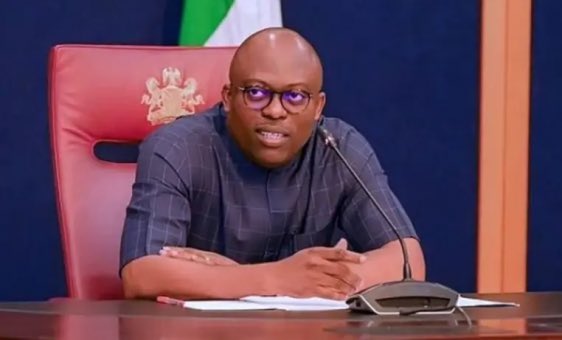
Rivers State Governor Siminalayi Fubara has disclosed that he met more than ₦600 billion in the state’s coffers at the conclusion of the emergency rule period, a revelation that has instantly reignited conversations around governance, accountability, and the handling of public funds in one of Nigeria’s most politically sensitive states.
Speaking while addressing stakeholders, the governor said the huge sum was what his administration inherited when normal democratic governance was restored, stressing that his government remains fully committed to prudent, transparent, and people-focused management of the state’s resources. The statement, brief but weighty, landed like a thunderclap in Rivers’ already charged political atmosphere, instantly drawing reactions from supporters, critics, and neutral observers alike.
Fubara’s disclosure comes at a time when Rivers State is still navigating the aftershocks of prolonged political tension, administrative uncertainty, and the extraordinary circumstances that led to emergency governance structures. For months, the state was the epicenter of national political debate, with institutions strained and governance operating under intense scrutiny. Against that backdrop, the revelation of over ₦600 billion sitting in state coffers has raised eyebrows and sparked a flood of questions: how was the money accumulated, what portions were committed, and how will it now be deployed?
The governor appeared keenly aware of the sensitivity of the issue. In reaffirming his commitment to transparency, Fubara emphasized that his administration would not treat the inherited funds as a windfall to be spent recklessly, but as a trust belonging to the people of Rivers State. According to him, the priority is to ensure that every naira is accounted for and directed toward projects that deliver measurable impact on infrastructure, social services, and economic development.
Within political circles, the disclosure has been interpreted in different ways. Supporters of the governor argue that the existence of such a substantial balance demonstrates that the state is not broke, contrary to narratives that often trail periods of political crisis. They believe it gives Fubara a strong financial footing to implement his agenda without resorting to excessive borrowing, a major concern for many Nigerians wary of mounting subnational debts.
Others, however, see the revelation as opening a Pandora’s box. Critics have begun asking why, with such enormous funds available, Rivers State still struggles with visible infrastructure gaps, youth unemployment, and lingering social challenges. Some analysts argue that the focus should not just be on how much money was inherited, but on how effectively it was previously managed and how decisively it will now be utilized.
The timing of Fubara’s statement has also drawn attention. Coming amid ongoing political realignments and debates over control, loyalty, and authority within the state, the disclosure is seen by some as a subtle assertion of legitimacy and capacity. By publicly stating the financial position he met, the governor appears to be drawing a clear line between inherited realities and future accountability, signaling that his administration intends to be judged by outcomes rather than excuses.
Economists and public finance observers note that inheriting such a large sum presents both opportunity and risk. On one hand, it provides fiscal breathing space, enabling investments in long-delayed projects such as road networks, healthcare facilities, education infrastructure, and job-creation programs. On the other hand, it places the administration under an even brighter spotlight, as citizens will expect rapid, visible improvements that justify the scale of available resources.
For many residents of Rivers State, the news has been met with cautious optimism. In markets, campuses, and online spaces, conversations have shifted from political drama to expectations. People are asking what the money will mean for everyday life: better roads, improved security, functional hospitals, and meaningful employment opportunities. There is a growing sense that excuses are no longer acceptable when such resources are on the table.
Fubara, for his part, appears to be positioning transparency as a defining pillar of his leadership. By openly discussing the state of the treasury, he is setting a benchmark against which his administration will be measured. Observers note that this also places pressure on him to institutionalize strong financial controls, publish clear expenditure plans, and regularly communicate progress to the public.
The revelation has also reignited broader national discussions about emergency rule periods and fiscal discipline. Some commentators argue that the ability of Rivers State to retain over ₦600 billion during such a turbulent phase raises questions about spending priorities, project execution, and the true cost of political instability. Others counter that it shows what is possible when leakages are minimized, even temporarily.
As the dust settles, one thing is clear: Governor Siminalayi Fubara has thrown a powerful figure into the public domain, and it cannot be taken lightly. The ₦600 billion is no longer just a number; it has become a symbol of expectation, scrutiny, and responsibility. How it is managed in the months and years ahead may well define not only Fubara’s tenure but also the future narrative of governance in Rivers State.
In a political environment where trust in leadership is fragile and public patience is thin, the governor’s words have set the stage for action. Rivers people will be watching closely, not for further statements, but for concrete results that prove that inheriting wealth is one thing, and translating it into real progress is another.
Popular Posts

Celebration Turns Sour as Craze Clown Exposes the Dark Side of Social Media After Daughter’s 5th Birthday Post
17 Dec, 2025
“I Don’t Like Controlling People”: Deeone Fires Back After Veekee James Says Smart People Don’t Take Him Seriously
17 Dec, 2025
“Any Guy Who Eats Breakfast Is a Barbie”: Ice Prince Sparks Debate as He Opens Up on His Weight Loss Journey
17 Dec, 2025Scroll to Top