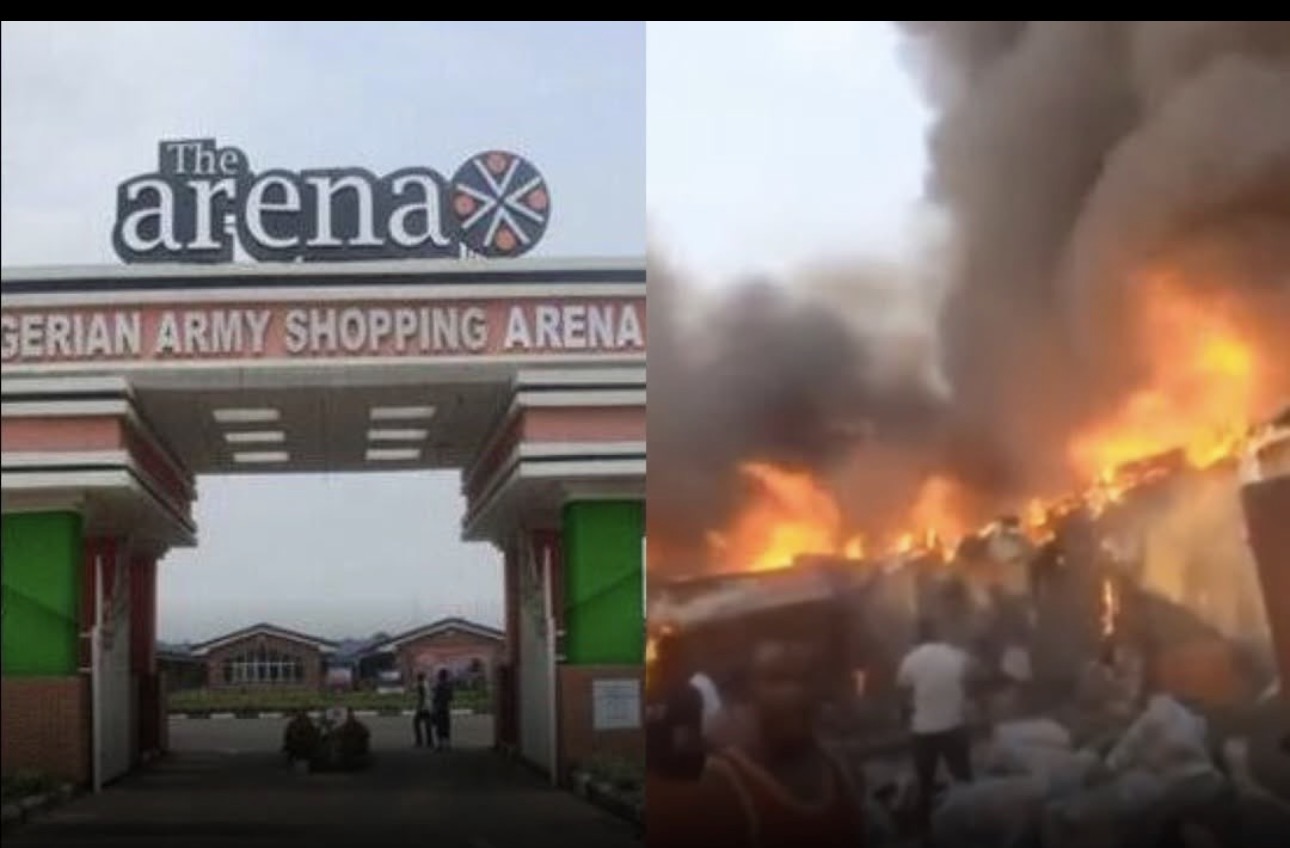
Panic swept through Lagos on Tuesday morning as a massive fire broke out at the popular Arena Oshodi Market, sending traders, shoppers and nearby residents scrambling for safety while thick plumes of smoke rose into the sky and could be seen from several kilometres away. The inferno, which reportedly started in the early hours of the day, quickly spread through sections of the bustling market, destroying goods worth millions of naira and reigniting fresh concerns about fire safety in Lagos’ crowded commercial centres.
Eyewitnesses said the fire began before dawn, when most traders were yet to arrive fully at their stalls, but a handful of early sellers and night guards raised the alarm after noticing flames licking through one of the locked sections of the market. Within minutes, the fire intensified, feeding on highly flammable materials such as textiles, plastics, wooden stalls and stored fuel generators that are common in many informal markets across the city. By the time daylight broke, the scene had turned into one of chaos, confusion and desperation.
Videos and photos that flooded social media showed raging flames consuming rows of shops, while traders wailed helplessly, some attempting to salvage what they could from the edges of the market. Others were seen collapsing in tears as years of investment went up in smoke. Thick black smoke choked the air, forcing people to flee the area and causing traffic gridlock along major roads connecting Oshodi to Mushin, Isolo and Mile 2.
Officials of the Lagos State Fire and Rescue Service were eventually deployed to the scene, battling the blaze with multiple fire trucks as curious onlookers gathered at a safe distance. According to preliminary accounts, firefighters faced serious challenges accessing the heart of the market due to narrow pathways, illegal structures and parked vehicles obstructing entry points. These obstacles, witnesses said, allowed the fire to spread rapidly before it could be brought under control.
A trader who sells clothes at the market, speaking in between sobs, said she arrived to find her entire shop already engulfed. She explained that she had stocked up heavily ahead of the festive season and had taken loans to do so. “Everything is gone,” she said. “My clothes, my money, everything. I don’t even know how to start again.” Her story echoed that of many others who depend solely on daily market sales to survive.
Arena Oshodi Market is one of the busiest trading hubs in Lagos, known for the sale of clothing, shoes, food items and household goods at relatively affordable prices. It attracts thousands of traders and customers daily from different parts of the state and beyond. Over the years, however, the market has also been plagued by recurring safety concerns, including poor electrical wiring, overcrowding and the absence of functional firefighting equipment within the premises.
As news of the fire spread, relatives of traders rushed to the scene, some frantically searching for loved ones amid the confusion. Although no official casualty figures were immediately released at the time of filing this report, emergency responders said their priority was to prevent loss of life while containing the fire. Several people were reportedly treated for smoke inhalation and minor injuries sustained during the rush to escape the blaze.
Security operatives, including the police and officials of the Lagos State Traffic Management Authority, were deployed to maintain order and divert traffic away from the area. Despite these efforts, tensions ran high as desperate traders attempted to bypass safety cordons in a bid to retrieve goods from their burning shops. Some were restrained by officials to prevent further injuries.
The cause of the fire had not yet been officially confirmed, but initial speculation among traders pointed to a possible electrical fault, a common trigger in many market fires across Nigeria. Others suggested that a generator explosion or unattended power source could have sparked the inferno. Authorities said a full investigation would be conducted once the fire was completely extinguished.
Market fires have become a recurring tragedy in Lagos and other major Nigerian cities, often leaving hundreds of families financially devastated. In recent years, similar incidents have been recorded at Balogun Market, Mile 12 Market and sections of the Trade Fair Complex, with traders repeatedly lamenting the lack of preventive measures and timely emergency response.
As firefighters continued their efforts, the smell of burnt materials hung heavily in the air, and the once-lively market was reduced to charred remains in several sections. Burnt metal roofs collapsed onto smouldering debris, while melted plastics and ashes covered the ground. For many traders, the scene marked not just the loss of goods but the destruction of livelihoods built over decades.
The Lagos State Government has consistently urged market associations to comply with safety regulations, including proper electrical installations, clear access routes for emergency vehicles and the provision of fire extinguishers. However, enforcement remains a challenge in informal and densely packed markets where survival often takes precedence over regulation.
Reactions poured in from across social media, with many Nigerians expressing sympathy for the affected traders while calling on authorities to do more to prevent such disasters. Some users criticised what they described as slow emergency response, while others urged the government to consider insurance schemes or emergency relief funds for market traders who lose everything to fires.
As the flames were gradually brought under control, attention turned to the aftermath and the difficult road to recovery for victims of the incident. Traders gathered in small groups, sharing stories of loss and trying to account for colleagues who were yet to be seen. For many, the questions were immediate and painful: how to repay loans, how to feed their families, and whether the market would ever return to normal.
The Arena Oshodi Market fire is the latest reminder of the vulnerability of informal economic spaces that sustain millions of Nigerians daily. Beyond the dramatic visuals and breaking news headlines lies a deeper issue of urban planning, safety enforcement and social protection for small-scale traders who form the backbone of the local economy.
As Lagos wakes up to the reality of another major market fire, affected traders can only hope that this tragedy will prompt concrete action rather than fleeting sympathy. For now, Arena Oshodi stands scarred and silent in parts, its ashes telling a familiar story of loss, resilience and the urgent need for change.
Just In: Chaos as f+re breaks out at Arena Oshodi Market, Lagos pic.twitter.com/bKZTCA5CuE
— Instablog9ja (@instablog9ja) December 30, 2025
Twitter Post
Visit websitePopular Posts

Yahaya Bello Declares 2027 Senate Ambition Amid Ongoing ₦80.2bn EFCC Trial
30 Dec, 2025
Fire From the Sky: Nigerian Army Confirms Heavy Blow to Lakurawa After U.S.-Led Airstrikes in Sokoto
30 Dec, 2025
“Send Them to Sambisa” — Shehu Sani’s Fiery Comment Ignites Fresh Debate on How Nigeria Should Confront Terrorism
30 Dec, 2025Scroll to Top