news
“More to Come”: U.S. Airstrike in Nigeria Signals Hardline Shift as Washington Vows to End Attacks on Christians
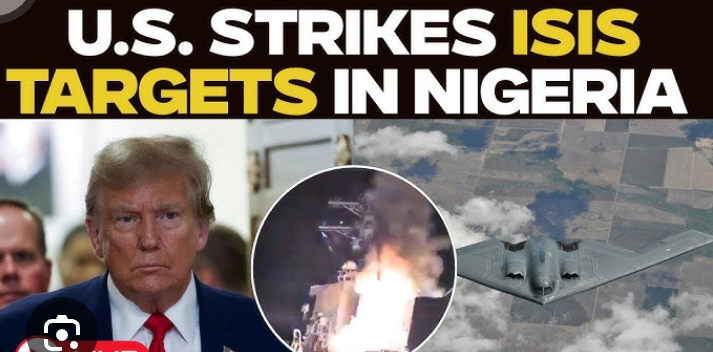
A late-night U.S. airstrike carried out in coordination with the Nigerian government has sent shockwaves across diplomatic, security, and religious circles, marking what American lawmakers and officials describe as the opening move in a tougher campaign against terrorist groups operating in Nigeria. The strike, announced on Christmas night, was quickly framed by senior voices in Washington as a warning to extremist factions accused of targeting Christian communities and destabilizing the country’s already fragile security landscape.
U.S. Representative Riley M. Moore was among the first to publicly interpret the operation as more than a one-off military action. In a strongly worded statement shared online, Moore said President Donald Trump had been unequivocal that the killing of Christians in Nigeria “must end,” adding that the strike should be seen as “just the first step” toward ending what he described as the slaughter of Christians and the wider security crisis affecting Nigerians of all faiths. His message was blunt, cautioning militant groups not to “test” the resolve of the U.S. president on the matter.
The airstrike, reportedly aimed at terrorist cells linked to ISIS affiliates operating in parts of Nigeria, came amid renewed international attention on the country’s complex conflict landscape. For years, Nigeria has battled multiple violent threats at once, including jihadist insurgencies in the northeast, armed banditry in the northwest, and communal clashes in the Middle Belt. While the violence cuts across religious and ethnic lines, Christian leaders and human rights organizations have long raised alarms over attacks on churches, clergy, and predominantly Christian villages, particularly in rural areas where state protection is weak.
Adding to the sense that Washington is preparing for sustained involvement, media personality and former U.S. military officer Pete Hegseth echoed the administration’s hardline tone in a post on X. He said the president had made it clear weeks earlier that the killing of innocent Christians in Nigeria and elsewhere would not be tolerated, declaring that the U.S. Department of Defense was “always ready” and that ISIS “found out tonight—on Christmas.” His closing words, “More to come,” fueled speculation that additional military actions or security measures could follow.
The timing of the strike, on Christmas Day, gave it powerful symbolism. Supporters of the action argued that it sent a clear message of solidarity to persecuted Christians and demonstrated that the U.S. was willing to act decisively. Critics, however, warned that the optics could inflame religious tensions or be interpreted as framing a complex conflict through a purely religious lens. Nigeria is home to Africa’s largest Christian population as well as one of its largest Muslim populations, and analysts often caution that oversimplifying the violence risks deepening divisions rather than resolving them.
Nigerian government officials have not released extensive details about the operation, but confirmation that it was coordinated suggests Abuja welcomed the support, at least at the operational level. Nigeria’s armed forces have struggled with overstretch and limited resources as they confront multiple security challenges simultaneously. International assistance, including intelligence sharing and targeted strikes, has long been part of the counterterrorism toolkit, though it remains politically sensitive due to concerns over sovereignty and civilian harm.
For Washington, the strike appears to align with a broader narrative of protecting religious freedom abroad, a theme that has gained traction among certain U.S. lawmakers and advocacy groups. Nigeria has repeatedly featured in U.S. congressional hearings and reports focused on global Christian persecution, with some calling for stronger measures, including sanctions or military cooperation, to pressure authorities and combat extremist groups. By framing the airstrike as a defense of Christians, figures like Moore are tapping into that discourse while also emphasizing that insecurity affects “all Nigerians,” not only one community.
On social media, reactions were swift and divided. Some Nigerian Christians expressed relief and gratitude, viewing the U.S. action as long-overdue international backing after years of fear and loss. Others, including Muslim leaders and civil society activists, urged caution, stressing that many victims of terrorism in Nigeria are Muslims and that violence should not be reduced to a religious narrative. They warned that extremists thrive on polarization and that lasting peace requires inclusive solutions addressing poverty, governance failures, and local grievances.
Security experts also pointed out that while airstrikes can disrupt militant networks and eliminate key figures, they are rarely decisive on their own. Terrorist groups in Nigeria have shown resilience, often splintering, relocating, or blending into civilian populations after military pressure. Without sustained ground operations, community engagement, and political reforms, analysts say, the impact of foreign strikes may be limited or even counterproductive.
Still, the language coming from Washington suggests that restraint may no longer be the preferred approach. By publicly linking the strike to a promise to end the killing of Christians and hinting at further action, U.S. officials appear intent on projecting resolve. For President Trump, whose foreign policy style often emphasizes strength and deterrence, Nigeria may now represent a stage on which to demonstrate that approach in Africa.
As Nigerians wake up to the news of the Christmas-night strike, questions remain about what comes next. Will the U.S. increase its military footprint or intelligence operations in the region? How will Nigerian authorities balance foreign assistance with domestic sensitivities? And most importantly, will ordinary Nigerians—Christian, Muslim, and others alike—see a real improvement in their daily security?
For now, the airstrike stands as a dramatic signal of intent rather than a solution in itself. Whether it marks the beginning of a sustained effort that brings relief to communities living under the shadow of violence, or simply another chapter in a long and painful conflict, will depend on actions yet to unfold. What is clear is that Nigeria’s security crisis has once again moved to the center of international attention, with Washington making it known that, in its view, the stakes are no longer negotiable.
Popular Posts

“They Can Strike, But They Can’t Save Us”: Shehu Sani’s Warning as Nigeria Debates U.S. Military Involvement
26 Dec, 2025
Empty Bombs, Loud Applause: Sarki Slams U.S. Lawmaker Over Nigeria Airstrike Celebration
26 Dec, 2025
Former Broadway ‘Lion King’ Star Imani Dia Smith Stabbed to Death at 26 by Boyfriend in New Jersey
26 Dec, 2025Scroll to Top