news
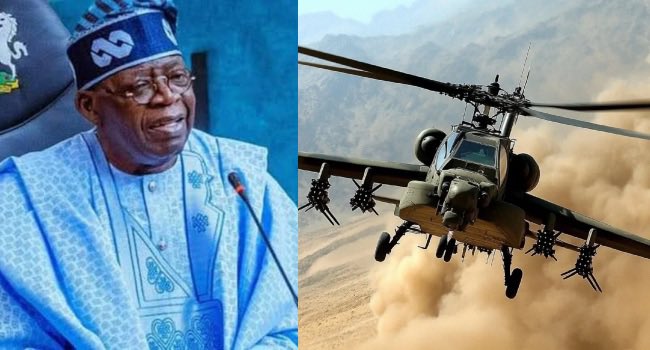
Tinubu Announces Arrival of Four US Attack Helicopters as Nigeria Intensifies Fight Against Insecurity
President Bola Ahmed Tinubu has announced that four attack helicopters will soon arrive in Nigeria from the United States, a development that underscores his administration’s determination to confront the country’s worsening security challenges head-on. The announcement comes at a time when insecurity, ranging from insurgency and banditry to kidnapping and violent crimes, continues to stretch the nation’s security architecture and test public confidence in the government’s ability to protect lives and property.
According to the president, the incoming helicopters form part of a broader effort to strengthen the operational capacity of Nigeria’s armed forces, particularly in areas where difficult terrain and fast-moving criminal groups have made conventional ground operations less effective. Attack helicopters, widely regarded as force multipliers in modern warfare, are expected to enhance surveillance, provide close air support to ground troops, and respond swiftly to security threats across affected regions.
Tinubu’s announcement has generated widespread reactions across the country, with many Nigerians viewing it as a significant step in addressing the deepening insecurity that has disrupted daily life, displaced communities, and affected economic activities. From the North-East, where insurgency has lingered for over a decade, to the North-West plagued by banditry, and parts of the South-East facing violent attacks and unrest, security remains one of the most pressing national concerns.
Since assuming office, President Tinubu has repeatedly emphasized that security is a top priority of his administration, describing peace and stability as the foundation upon which economic growth, investment, and national development must rest. The planned arrival of the helicopters aligns with this position, signaling a readiness to invest in advanced military assets to support ongoing security operations.
Military analysts note that air power has become increasingly critical in counter-insurgency and internal security operations, especially in vast and hard-to-reach areas. Helicopters offer flexibility that fixed-wing aircraft cannot always provide, including the ability to hover, operate at low altitudes, and support troops in real time. For Nigeria, whose security forces often operate across forests, mountains, and rural communities with limited road access, such capabilities could prove decisive.
The announcement also highlights Nigeria’s continued defense cooperation with the United States, a partnership that has spanned training, intelligence sharing, and equipment acquisition over the years. While details about the specific model and capabilities of the helicopters were not immediately disclosed, their procurement from the US reflects an effort to acquire platforms that meet modern operational standards and integrate effectively with existing military systems.
Public discourse following the announcement has reflected a mix of optimism and cautious expectation. Many Nigerians welcome any move that strengthens the armed forces, particularly as communities affected by violence continue to call for more visible and effective security presence. For families impacted by attacks, kidnappings, and displacement, the promise of enhanced air support offers hope that the tide could gradually turn in favor of peace.
At the same time, some commentators have stressed that military hardware alone cannot solve Nigeria’s security problems. They argue that while the arrival of attack helicopters is important, it must be complemented by improved intelligence gathering, better coordination among security agencies, and addressing the root causes of insecurity such as poverty, unemployment, and social grievances. In their view, sustainable security requires a comprehensive approach that combines force with dialogue, development, and justice.
President Tinubu has acknowledged these broader dimensions in previous statements, noting that security challenges are complex and demand both immediate and long-term solutions. His administration has pledged to reform the security sector, improve the welfare of security personnel, and invest in technology and training to enhance effectiveness. The helicopters, therefore, are being framed not as a standalone solution but as part of a wider strategy.
The timing of the announcement is particularly significant, coming amid renewed concerns over attacks on communities and critical infrastructure in various parts of the country. Reports of violence have continued to dominate headlines, fueling public anxiety and increasing pressure on the federal government to deliver tangible results. Against this backdrop, the promise of new military assets is seen as a signal that the government is taking decisive steps.
Economically, insecurity has had far-reaching consequences, discouraging investment, disrupting agriculture, and increasing the cost of doing business. Tinubu’s broader economic agenda, which includes attracting foreign investment and boosting local production, is closely tied to improvements in security. Without safety, analysts argue, economic reforms may struggle to gain traction. The president’s focus on strengthening security capabilities is therefore closely linked to his vision for economic recovery and growth.
Opposition figures and civil society groups have also weighed in, urging transparency and accountability in defense spending and deployment. They emphasize the importance of ensuring that new equipment is properly maintained, effectively deployed, and used in a manner that respects human rights and the rule of law. Past experiences, they note, have shown that procurement alone does not guarantee improved outcomes without strong oversight and strategic planning.
For the military, the arrival of the helicopters is expected to boost morale and operational confidence. Security sources suggest that additional air assets could improve response times and provide critical support in joint operations involving the army, air force, and other security agencies. In regions where criminals have exploited difficult terrain to evade capture, enhanced aerial capability could help close that gap.
As Nigerians await the arrival of the helicopters, expectations remain high. Many citizens will be watching closely to see whether this development translates into measurable improvements on the ground, including reduced attacks, safer communities, and the restoration of normalcy to areas long affected by violence. The administration’s challenge will be to ensure that the promise of stronger air power is matched by effective strategy and coordination.
President Tinubu’s announcement marks another defining moment in his administration’s approach to national security. While the road to lasting peace remains complex and demanding, the planned arrival of four US attack helicopters signals a clear intent to strengthen Nigeria’s capacity to confront its security challenges. For a nation yearning for stability, the move represents both a statement of resolve and a test of whether enhanced military capability can help turn the page toward a safer future.
Popular Posts

Royal Drums and Rising Profiles: Seyi Tinubu and Wife Layal Honoured With New Chieftaincy Titles in Lagos
26 Dec, 2025
Burna Boy’s $100,000 Gesture Sparks Conversation as VeryDarkMan Reveals Major Donation for Hospital Bills and Prisoner Support
26 Dec, 2025
From Child Star to Christmas Hospital Bed: The Troubling Turn in Tylor Chase’s Life
26 Dec, 2025Scroll to Top