Entertainment
“From Pickup Truck to Private Jet”: Tiwa Savage Shuts Down Critic Over Delta Performance, Sparks Conversation on Respect, Status, and Stardom
Nigerian music icon Tiwa Savage has once again found herself at the center of social media conversation after delivering a sharp, unapologetic response to a critic who berated her for arriving at a performance venue in Delta State on the back of a truck. What began as a seemingly harmless behind-the-scenes moment from a live show quickly spiraled into a viral exchange, reigniting debates about celebrity image, humility, respect for elders, and the often unforgiving standards placed on female entertainers in Nigeria’s music industry.
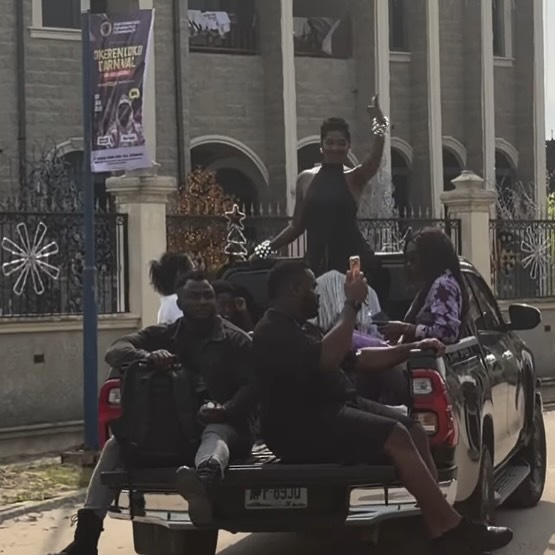
The incident unfolded after a clip surfaced online showing Tiwa Savage riding on the back of a pickup truck en route to a stage performance in Delta State. For many fans, the moment was unremarkable, even admirable. In regions where logistics, crowd control, and security can complicate event access, such improvisation is not uncommon. To supporters, the scene reflected a seasoned performer focused on delivering for her audience, regardless of optics. However, one social media user, identified as @marcussmth04, saw it differently and left a disparaging comment suggesting that the award-winning singer was “downgrading” herself by appearing in such a manner.
“Omo Tiwa downgrading herself,” the critic wrote, a statement that quickly drew attention due to the singer’s stature as one of Africa’s most successful female artists. Tiwa Savage, who has built a career spanning more than a decade, with international collaborations, sold-out shows, and global recognition, did not ignore the comment. Instead, she fired back with a response that was as blunt as it was viral.
“Went from a pickup truck to a Gulfstream,” Tiwa replied, referencing her access to a private jet and underscoring the vast difference between momentary logistics and long-term success. She followed the statement with a pointed remark about respect, adding that she had more money than the critic’s father, a phrase that instantly became a trending quote across Nigerian social media spaces.
The response divided opinion almost immediately. Supporters applauded Tiwa Savage for refusing to shrink herself to appease online critics, praising her confidence and refusal to accept what they viewed as unnecessary disrespect. To them, the singer’s clapback was a reminder that success is not erased by a single moment or mode of transportation. They argued that artists should not be boxed into rigid expectations of glamour at all times, especially when performing for fans in less conventional settings.
Others, however, felt the response was excessive, arguing that celebrities, particularly those regarded as role models, should exercise restraint when engaging critics online. Some suggested that the reference to wealth and family crossed a line, even if provoked. Yet even among critics of her tone, there was acknowledgment that the original comment reflected a deeper issue within online culture: the readiness to diminish accomplished women over trivial details.
Beyond the immediate exchange, the incident has opened up broader conversations about what fans and critics expect from celebrities, especially female stars. Tiwa Savage’s career has been marked by constant scrutiny, from her fashion choices to her personal life and performance style. The truck performance critique fits into a familiar pattern where women in the public eye are judged not only by their talent but by how well they maintain an image of luxury and perfection at all times.
Industry insiders have noted that arriving at shows via unconventional means is far from unusual, particularly in areas where infrastructure challenges, security concerns, or crowd density make standard vehicle access impractical. In such cases, trucks, bikes, or even walking through crowds become necessary. For many artists, these moments are not indicators of decline but examples of adaptability. Tiwa Savage’s reference to moving “from a pickup truck to a Gulfstream” was, to her fans, a concise way of saying that a single clip does not define a career built on years of hard work and global success.
The phrase “una no get respect for your elders,” which formed part of her response, also resonated culturally. In Nigerian society, respect for elders remains a deeply ingrained value, and Tiwa’s comment tapped into a sentiment shared by many older fans who feel that social media has emboldened younger users to speak carelessly to people they would otherwise approach with deference offline. Her age, experience, and achievements, supporters argued, warranted more thoughtful commentary than a dismissive jab about “downgrading.”
As the exchange continued to circulate, blogs, fan pages, and entertainment commentators weighed in, with many pointing out the irony of labeling Tiwa Savage as “downgraded” at a time when she continues to headline major shows, collaborate with international stars, and maintain relevance in a highly competitive industry. The Delta State performance itself was reportedly well-received, with attendees praising her energy and connection with the crowd, a detail that further weakened the critic’s argument in the eyes of her supporters.
The moment has also highlighted the evolving relationship between celebrities and their audiences in the age of social media. Platforms like Instagram and X have collapsed the distance between stars and fans, making direct engagement easier but also exposing artists to constant criticism. While some celebrities choose silence, others, like Tiwa Savage, occasionally opt to respond directly, asserting boundaries and reclaiming narratives about their lives and careers.
Whether one agrees with the tone of her reply or not, the impact is undeniable. Tiwa Savage’s response dominated conversations for hours, reinforcing her reputation as an artist unafraid to speak her mind. It also served as a reminder that behind the polished images and curated performances are real people navigating complex environments, making split-second decisions to fulfill professional commitments.
In the end, the truck-to-stage moment in Delta State may fade from memory, but the conversation it sparked about respect, success, and perception is likely to linger. For Tiwa Savage, the episode appears to have reaffirmed her stance on self-worth and legacy. As she continues to perform, record, and represent Nigerian music on global stages, one thing is clear: a pickup truck does not define a superstar, and neither does a comment section.
Popular Posts

Former Attorney-General Abubakar Malami to Remain in Custody as Court Defers Bail Ruling to January 7
02 Jan, 2026
₦1.4 Trillion on the Table: How Nigeria’s Food Import Bill Exposes a Deeper Economic Dependence
02 Jan, 2026
“The Dog Is Barking”: Wike Fires Back at Fubara in a Fresh Political Storm
02 Jan, 2026Scroll to Top