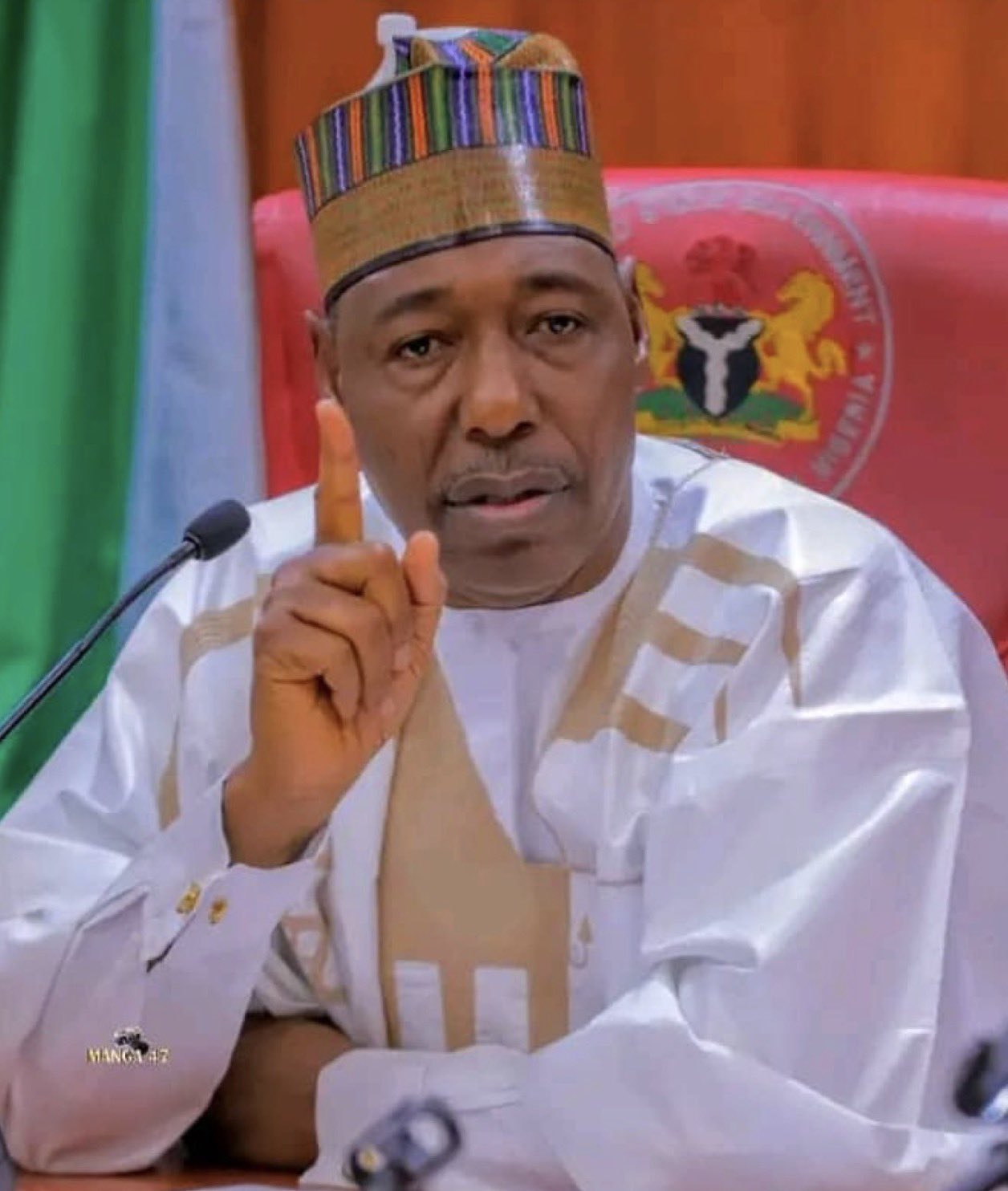
Borno State Governor, Babagana Umara Zulum, has revealed that his administration has committed a staggering sum of N100 billion to security operations and interventions across the state in 2025 alone, a disclosure that once again throws a sharp spotlight on Nigeria’s lingering war against insurgency and banditry in the North-East.
The governor made this revelation while addressing stakeholders on the state’s ongoing security challenges, describing the fight as one that demands not just political will but relentless financial and human commitment.
For a state that has borne the terrifying scars of Boko Haram and ISWAP for over a decade, Zulum’s declaration is not just a statistic but a grim reflection of the price of survival. From destroyed villages to displaced families, orphaned children, and battered infrastructure, Borno remains one of Nigeria’s most traumatized regions.
The N100 billion figure, according to the governor, cuts across intelligence gathering, logistics support, military coordination, community protection initiatives, reconstruction of destroyed security formations, welfare for affected victims, and emergency response systems across the 27 local government areas of the state.
Zulum’s statement landed at a time when Nigerians are increasingly questioning the effectiveness of massive security spending across the country. With insecurity still claiming lives daily — from insurgency in the North-East, banditry in the North-West, kidnapping in the Middle Belt, and cult violence in the South — many citizens are demanding to know where the money is truly going and how much impact it is making. Yet Zulum insists that without the aggressive funding, the situation in Borno could have spiraled into total collapse.
Those close to the state’s security architecture confirm that the governor has remained unusually hands-on compared to many of his counterparts. Zulum is known for personally leading security assessments, visiting frontline communities without heavy publicity, and holding late-night strategy meetings with military commanders. The N100 billion, according to insiders, reflects not just federal allocations but massive state-backed emergency funding released under tight timelines whenever new security threats emerge.
Despite the spending, the menace has not completely disappeared. Rural communities still face attacks, humanitarian workers remain targets, and displaced persons continue to occupy camps across Maiduguri and surrounding towns. But residents admit that the scale of devastation has reduced compared to the horrors of the mid-2010s when entire towns were emptied overnight by insurgents. Markets that once stood abandoned are slowly reopening. Schools that once served as IDP shelters are being reclaimed for learning. These, supporters argue, are the quiet gains of relentless security investment.
Zulum’s revelation has, however, sparked intense national debate. Many Nigerians see the N100 billion figure as both impressive and troubling. Impressive because it shows a rare level of financial prioritization for security at the state level. Troubling because it exposes just how expensive peace has become in Nigeria. In a country battling inflation, unemployment, hunger, and a collapsing naira, questions are being raised about how long such spending levels can be sustained without crippling social development.
Opposition voices have also begun demanding transparency. Civil society groups are calling for a public audit of the N100 billion to ensure that the funds were not lost to inflated contracts, ghost projects, or mismanaged procurements — accusations that have haunted security spending across Nigeria for years. Some analysts argue that even half of that amount, if properly deployed into education, youth employment, and infrastructure, could significantly weaken the recruitment pool for insurgent groups.
Yet security experts counter that Borno does not have the luxury of delayed choices. They insist that the state sits at the epicenter of Nigeria’s terror wave and that any lapse in security funding can reverse years of sacrifices within weeks. Military sources have repeatedly warned that insurgent groups remain deeply embedded in remote forests, using sophisticated tactics funded by regional criminal networks stretching across the Sahel.
Within Borno itself, reactions remain mixed but emotionally charged. Some residents commend Zulum for standing firm and not abandoning the war, describing him as “a governor fighting a war no governor asked for.” Others, particularly families of fallen soldiers and slain civilians, argue that no amount of money can replace the lives already lost. Many displaced persons also question why, despite the billions spent, they are still living in camps after years of promises.
What makes Zulum’s statement even more powerful is the political backdrop surrounding it. Across Nigeria, governors rarely disclose real security budgets with such bluntness. Many prefer vague figures wrapped in “security votes” that are constitutionally protected from public scrutiny. By openly placing N100 billion on record, Zulum has unintentionally thrown down a challenge to other state leaders to match both his spending and his transparency.
The revelation also reignites the broader conversation around federal responsibility. Security remains constitutionally assigned to the federal government, yet states like Borno now spend enormous portions of their internally generated revenue and federal allocations on defense. This imbalance, analysts say, is slowly forcing governors into the role of regional war commanders rather than administrators of development.
As Nigeria moves deeper into 2025 with no clear end in sight to insecurity, Zulum’s words feel less like a boast and more like a warning — a warning that peace is no longer cheap, and survival now carries a price tag running into hundreds of billions. Whether the spending will finally outpace the violence remains a question only time, strategy, and accountability can answer.
For now, Borno continues to stand at the frontline of Nigeria’s most brutal battle, with N100 billion poured into the shield holding back chaos, one operation, one patrol, and one fragile community at a time.
Popular Posts

“‘Let Those Who Want to Die, Die in Peace’ — Tacha Sparks Outrage as She Slams Aunty Esther for Rejecting Blood Transfusion After ₦30m Donation”
05 Dec, 2025
“DEY PLAY”: MERCY AIGBE TEASES DAUGHTER MICHELLE AFTER SHE SAYS SHE DOESN’T WANT A BIG WEDDING
05 Dec, 2025
Silent Hands Behind the Chaos: Retired Major General Ali-Keffi Alleges High-Level Links to Terror Suspects in Explosive Revelation
05 Dec, 2025Scroll to Top