news
Night of Fear at Owerri Airport as Small Aircraft Somersaults During Emergency Landing, Four Hospitalised
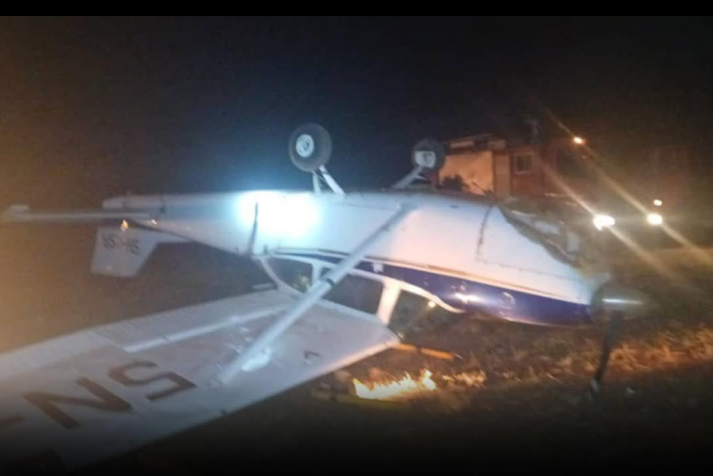
What began as a routine domestic flight on a quiet Tuesday evening quickly turned into a heart-stopping ordeal when a small aircraft somersaulted while attempting an emergency landing at the Sam Mbakwe International Cargo Airport in Owerri, Imo State. The incident, which occurred around 8:00 pm, sent shockwaves through Nigeria’s aviation community and sparked renewed conversations about flight safety, emergency preparedness, and the resilience of airport response systems.
The Nigerian Safety Investigation Bureau (NSIB) confirmed that the aircraft involved was a Cessna 172 operated by Skypower Express. Registered as 5N-ASR, the plane had departed Kaduna International Airport en route to Port Harcourt International Airport when the unexpected unfolded mid-air. According to official details, the crew encountered an in-flight emergency that forced them to divert from their original destination and seek an immediate landing in Owerri.
As the aircraft descended toward Runway 17 under tense conditions, what followed was a dramatic crash landing that saw the plane somersault on impact. The frightening sequence could have easily resulted in fatalities, but in a stroke of relief amid the chaos, all four occupants survived. They were swiftly rushed to a nearby hospital for medical attention, and authorities later confirmed that no lives were lost.
In a statement released by the NSIB’s Director of Public Affairs and Family Assistance, Mrs. Bimbo Oladeji, the bureau reassured the public that emergency services at the airport were activated without delay. Rescue teams moved in quickly to secure the scene, attend to the injured occupants, and prevent further danger. One particularly significant detail noted in the statement was the absence of a post-crash fire, a factor that greatly reduced the risk of additional injuries or fatalities.
Eyewitness accounts from airport staff and nearby observers described moments of panic as the aircraft struggled during its final approach. The sight of the plane overturning on the runway reportedly caused brief alarm among passengers and workers within the airport vicinity. However, the swift response of emergency personnel helped calm fears and ensured that the situation did not spiral further.
Remarkably, despite the severity of the incident, flight operations at the airport were not disrupted. The runway remained active, and other aircraft were able to take off safely after the accident. This detail, highlighted by the NSIB, underscored the efficiency of the airport’s emergency management protocols and the ability of authorities to isolate the affected area without grounding operations entirely.
As night fell over Owerri, attention shifted from the immediate rescue efforts to the critical task of investigation. The damaged aircraft remained at the scene as arrangements were made to evacuate it for a thorough technical examination. Aviation experts note that such examinations are essential not only to determine the exact cause of the accident but also to prevent similar incidents in the future.
The Director-General of the NSIB, Captain Alex Badeh Jr., confirmed that the bureau had activated its full investigation protocols. According to him, investigators are already coordinating with relevant authorities to secure the crash site and gather evidence, including flight data, maintenance records, and eyewitness reports. He assured the public that updates would be provided as the investigation progresses, emphasizing the bureau’s commitment to transparency and safety.
While the NSIB has taken the lead in addressing the incident, notable silence followed from other key aviation bodies. As of the time this report was filed, neither the Nigerian Civil Aviation Authority (NCAA) nor the Federal Airports Authority of Nigeria (FAAN) had issued official statements regarding the crash. Their eventual responses are expected to shed more light on regulatory and operational aspects surrounding the event.
The incident has reignited public interest in the safety of light aircraft operations within Nigeria’s airspace. The Cessna 172, widely regarded as one of the most reliable and commonly used light aircraft globally, is often employed for training, charter services, and short-haul flights. Its involvement in such a dramatic accident has led many to question whether factors such as weather conditions, mechanical failure, pilot decision-making, or airport infrastructure played a role.
Aviation analysts stress that emergency diversions, while rare, are not unusual in flight operations and are often handled safely. However, when an emergency landing results in an aircraft overturning, it raises concerns that warrant close scrutiny. Each detail, from the declaration of the in-flight emergency to the final moments on approach, will likely be examined meticulously by investigators.
For the families and loved ones of the four occupants, the incident was a terrifying reminder of how quickly circumstances can change in the air. Yet, the absence of fatalities has been widely described as a blessing, with many praising the crew’s ability to attempt a controlled landing despite the emergency. Social media reactions following the news were filled with relief, prayers for the injured, and commendations for the rapid response of emergency services at the airport.
Beyond the immediate human impact, the crash serves as a sobering moment for Nigeria’s aviation sector. It highlights the importance of continuous training, strict maintenance standards, and robust emergency response systems. Incidents like this, though unfortunate, often lead to improvements in safety measures and operational procedures when properly investigated and addressed.
As the damaged aircraft awaits evacuation and investigators piece together the sequence of events, the nation watches closely for answers. The findings of the NSIB’s investigation will not only determine what went wrong on that tense Tuesday night but also shape future safety recommendations for operators and regulators alike.
For now, Owerri Airport has returned to its usual rhythm, the runway once again serving departing and arriving flights under calm skies. Yet the memory of the somersaulting aircraft lingers as a stark reminder of the risks inherent in aviation and the thin line between disaster and survival. The hope remains that lessons learned from this incident will strengthen Nigeria’s aviation safety framework and ensure that such a night of fear is not repeated.
Popular Posts

FIFA Probe Rocks DR Congo After Penalty Win Over Nigeria as Super Eagles’ World Cup Hopes Get Surprise Lifeline
16 Dec, 2025
“I Owe You Loyalty Forever”: IVD’s Emotional Tribute to Blessing CEO After Release From Prison Custody
16 Dec, 2025
Nigeria Back in the 2026 World Cup Race as FIFA Probes DR Congo Eligibility, Analyst Reveals
16 Dec, 2025Scroll to Top