Entertainment
“She Just Said ‘Ok’: Toke Makinwa Shrugs Off ‘666’ Accusation and Sparks Online Debate
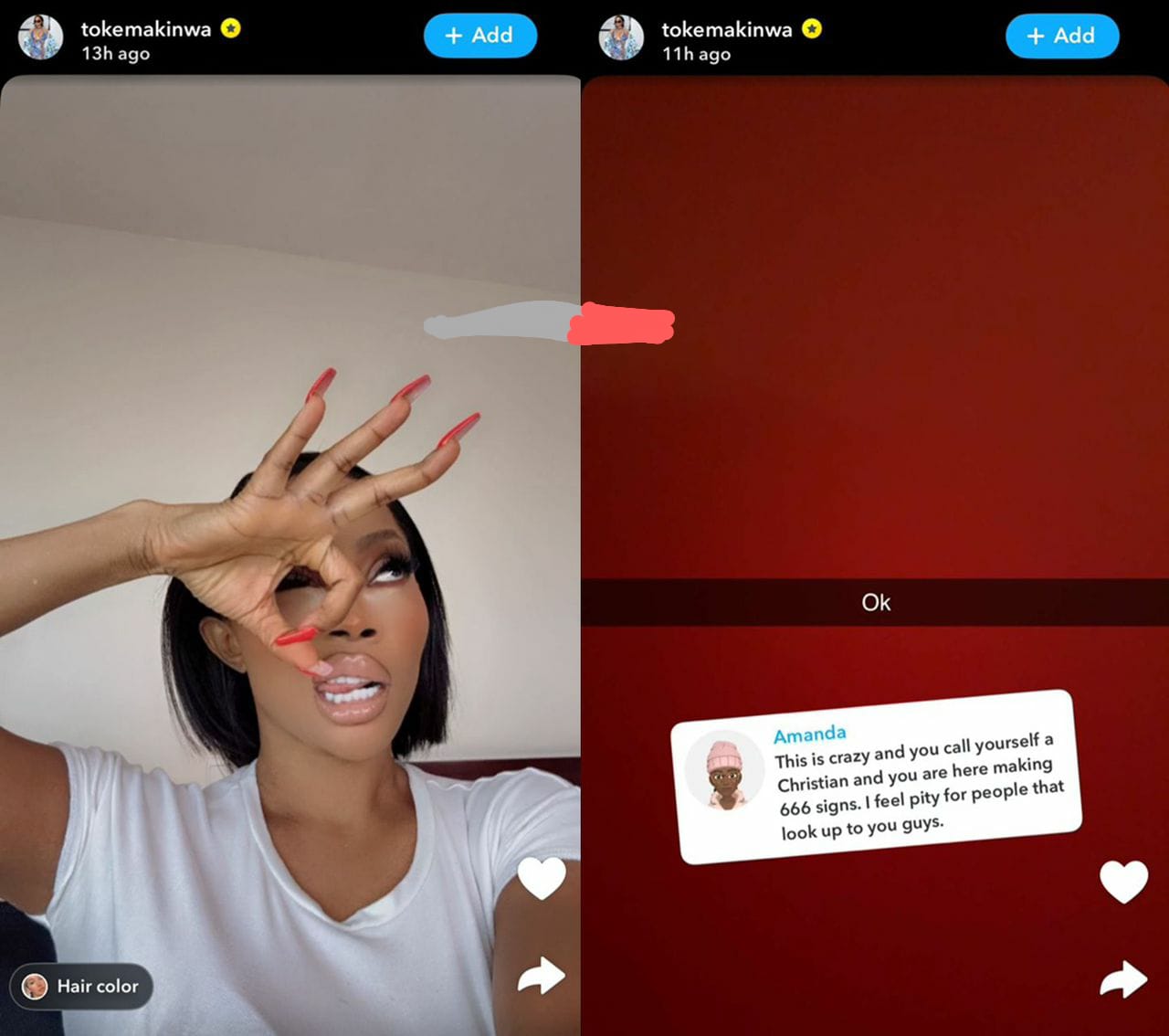
Popular Nigerian media personality and entrepreneur Toke Makinwa has once again found herself at the center of social media conversation after responding to a follower who accused her of making a “666” sign despite openly identifying as a Christian. The accusation, which surfaced under one of her recent social media posts, quickly drew attention not because of its substance, but because of Toke’s unusually brief and calm response. Rather than engage in a lengthy defense or emotional explanation, the media star simply replied with one word: “Ok.”
The exchange, though short, was enough to ignite widespread reactions across social media platforms, particularly on X, Instagram, and blogs that closely follow celebrity activity. Screenshots of the comment and her response began circulating almost immediately, with fans and critics alike dissecting what the moment meant, not just for Toke Makinwa, but for the larger conversation around religion, symbolism, and celebrity culture in Nigeria.
The accusation itself stemmed from a hand gesture Toke made in a photo or video she shared online. A follower interpreted the pose as a representation of the so-called “666 sign,” a number often associated in Christian theology with the devil or the Antichrist. The commenter questioned how someone who publicly professes Christianity could be comfortable making such a sign, framing the observation as both a spiritual concern and a moral call-out. While such claims are not new in the world of social media, especially when celebrities are involved, the way Toke chose to respond made this incident stand out.
Instead of pushing back or offering clarification, Toke’s simple “Ok” was widely interpreted as a deliberate refusal to dignify the accusation with further explanation. For many of her supporters, the response was classic Toke: confident, unbothered, and unwilling to be dragged into unnecessary online debates. Fans praised her restraint, noting that social media often pressures public figures to constantly explain themselves, especially on matters of faith and personal belief.
Others, however, saw the response differently. Some critics argued that the brevity came off as dismissive, particularly given the seriousness with which many Nigerians view religious symbolism. In a country where Christianity and Islam play significant roles in everyday life, issues of faith are rarely taken lightly. For these observers, the accusation, though speculative, touched on deeply held beliefs, and they felt a clearer response might have helped avoid misinterpretation.
Still, many commentators pointed out that the idea of a universal “666 hand sign” is largely rooted in internet conspiracy theories rather than established religious doctrine. Over the years, countless celebrities across the world have been accused of secretly promoting occult or satanic symbols based on hand gestures, fashion choices, or artistic expressions. In most cases, these claims rely heavily on personal interpretation rather than factual evidence. Toke’s supporters were quick to remind critics that a hand pose in a photograph does not equate to a spiritual declaration.
The moment also reopened conversations about the unrealistic expectations placed on celebrities, especially those who are open about their faith. Toke Makinwa has never hidden the fact that she is a Christian, and she has spoken in the past about prayer, personal growth, and spirituality, particularly in relation to her life experiences and relationships. For many fans, that history made the accusation feel unfair and intrusive, as if her faith was being policed by strangers online.
Beyond religion, the incident highlighted a broader social media pattern where public figures are constantly scrutinized for symbolic meaning in their everyday actions. In the age of viral screenshots and instant commentary, even the smallest gesture can be magnified and assigned intent. Toke’s one-word response seemed to push back against that culture, suggesting that not every claim deserves a detailed rebuttal.
Several Nigerian celebrities and influencers subtly weighed in by liking posts or sharing opinions that leaned toward minding one’s business and allowing people practice their faith privately. While none directly referenced Toke by name, the timing made it clear the conversation was connected. Fans also flooded her page with supportive comments, praising her for staying focused on her work and not allowing distractions to derail her public image.
For Toke Makinwa, whose career spans radio, television, fashion, beauty, and entrepreneurship, controversies and online chatter are hardly new territory. Over the years, she has been the subject of intense public discussion about her relationships, lifestyle, opinions, and success. Yet she has managed to remain relevant and influential, often choosing silence or minimal responses over public back-and-forths. This latest incident fits neatly into that pattern.
The reaction to her “Ok” response also says a lot about how audiences engage with celebrities today. In a digital environment where outrage often thrives on extended arguments and emotional reactions, refusing to engage can be a powerful statement. For some, Toke’s response symbolized confidence and self-assurance, a reminder that not every narrative needs to be corrected or countered.
At the same time, the episode underscores how deeply intertwined faith, identity, and public perception are in Nigerian society. When celebrities express religious affiliation, they are often held to standards that go beyond personal belief and extend into public performance. Any perceived deviation, no matter how small, can become grounds for criticism or suspicion. Toke’s response, intentional or not, challenged that expectation by asserting her right to disengage.
As the online buzz gradually settles, the incident is likely to become just another footnote in the ever-evolving story of celebrity life in the age of social media. Yet it leaves behind an important question about boundaries, belief, and the pressure to constantly explain oneself in a public space. For now, Toke Makinwa appears unfazed, continuing to post, promote her brand, and engage with her audience on her own terms.
In the end, what lingered most from the exchange was not the accusation itself, but the simplicity of the response. In a space often dominated by noise, Toke Makinwa’s quiet “Ok” spoke loudly, reminding many that sometimes, silence or minimalism can be the most powerful reply of all.
Popular Posts

“I Owe You Loyalty Forever”: IVD’s Emotional Tribute to Blessing CEO After Release From Prison Custody
16 Dec, 2025
Nigeria Back in the 2026 World Cup Race as FIFA Probes DR Congo Eligibility, Analyst Reveals
16 Dec, 2025
“The Bouquet Is the Message”: Odumodublvck’s Dollar Demand Sparks a New Debate on Love, Clout, and the Cost of Romance in Nigeria
16 Dec, 2025Scroll to Top